
Ramon Lachmansingh for Canada Cricket Online
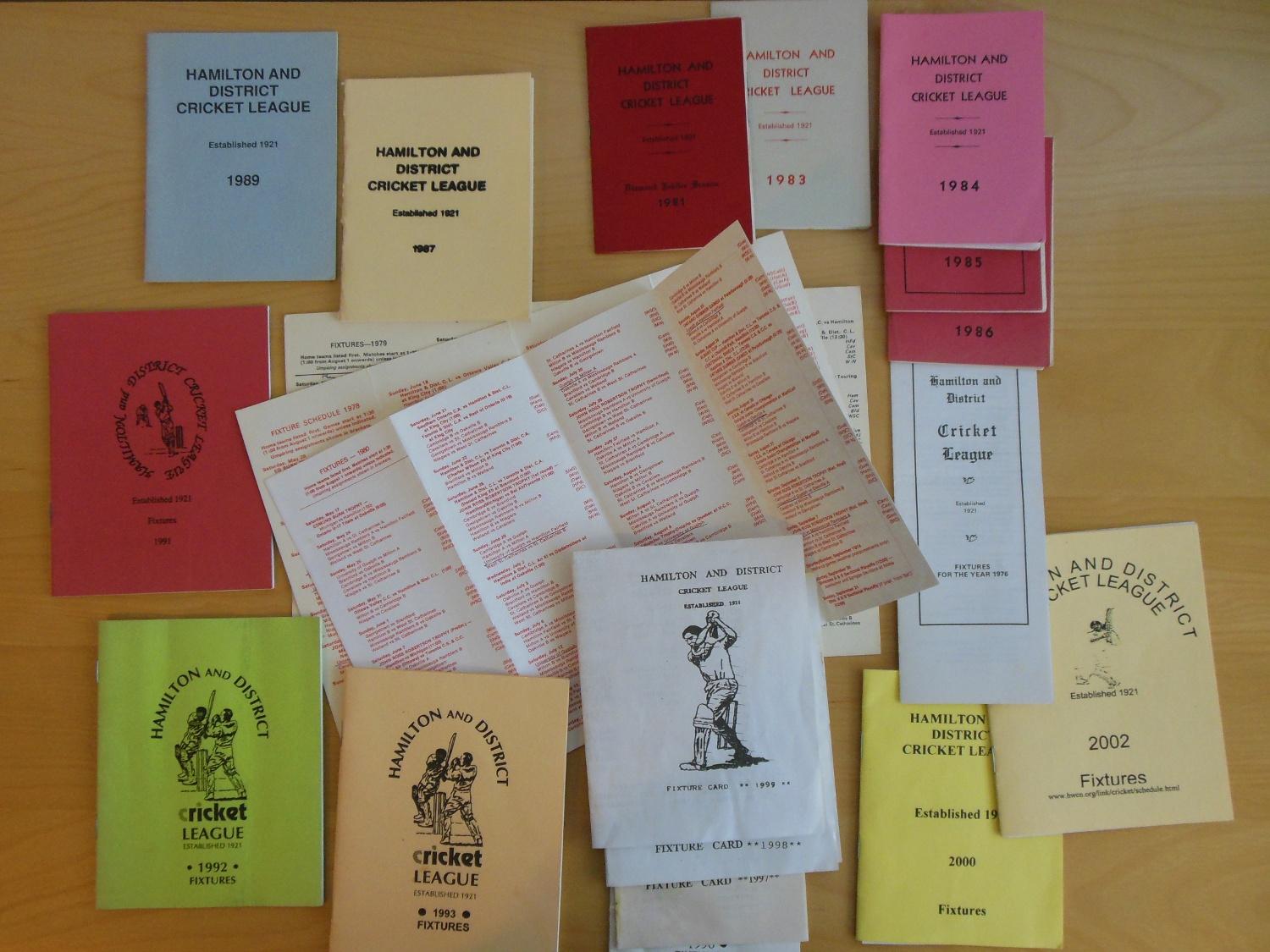
H&DCL Fixtures
The Hamilton and District Cricket League is Southern Ontario-based association founded in 1921. Its boundaries have been fluid but in recent times stretch from Mississauga in the northeast, to Cambridge in the west and to the American boarder (and even across) in the southeast. The league is somewhat atypical in Canadian cricket circles. Whereas most leagues are now centred on a single large municipality, the H&DCL is made up of clubs representing several communities and spread over considerable distances. As a result, clubs draw on a limited number of players and are more vulnerable to the immigration trends cricket has felt over recent decades.
An overview of the 1976-2002 era provided through a series of printed fixture lists reveals the changes the league has undergone.
| Season | Clubs |
# of Teams |
Notes | |
| ‘A’ Division | ‘B’ Division | |||
| 1976 | 13 | 8 | 8 | |
| 1978 | 11 | 8 | 9 | Grimsby (a community from the H&DCL’s early days) and Buffalo Wanderers CC (the only U.S.-based club) have exited the league; Welland-Niagara CC fielding two separate ‘B’ sides: Welland and Niagara. |
| 1979 | 14 | 10 | 10 | Cambridge CC, Georgetown CC and Guelph CC join league |
| 1980 | 14 | 9 | 12 | |
| 1981 | 13 | 10 | 10 | Welland-Niagara CC fielding a single team; Hamilton Fairfield and Cavaliers (Hamilton) merge |
| 19821 | 12 | 9 | 10 | Fairfield-Cavaliers club folds |
| 1983 | 12 | 10 | 10 | |
| 19842 | 11 | 7 | 10 | Milton CC did not play 1984 season |
| 1985 | 12 | 6 | 10 | Milton CC returns to ‘B’ division. Guelph CC consolidates to ‘A’ division |
| 1986 | 11 | 5 | 11 | West St. Catharines club (est. 1932) folds;
League adds “H&DCL Juniors” team to ‘B’ division – comprised of junior players from several clubs |
| 1987 | 9 | 7 | 7 | Welland-Niagara club does not field a team in 1987; Georgetown CC unable to field a team |
| 19883 | 10 | 6 | 10 | University of Guelph CC (est. 1957) folds; Welland-Niagara and Georgetown clubs return; Guelph CC add team to ‘B’ division |
| 1989 | 10 | 6 | 10 | |
| 1991 | 10 | 5 | 11 | Oakville CC (est. 1919) has folded; Crescent CC (Hamilton) joins; new United CC (Hamilton) playing friendlies |
| 1992 | 11 | 5 | 12 | United CC joins ‘B’ division |
| 1993 | 11 | 5 | 10 | Hamilton CC and St. Catharines CC consolidate to ‘A’ division. |
| 1996 | 10 | 5 | 6 | Milton (est. 1973) and Welland-Niagara (est. 1869) clubs have folded; Five Star CC (Hamilton) joins league; the H&DCL Juniors and new Blue Vets club (Hamilton) are playing friendlies; Guelph CC again consolidate to ‘A’ division |
| 1997 | 11 | 5 | 9 | Blue Vets join ‘B’ division |
| 1998 | 10 | 5 | 7 | United CC disbanded |
| 1999 | 9 | 11 | – | Five Star CC folds; H&DCL ‘B’ division eliminated |
| 2000 | 7 | 10 | – | Crescent and Blue Line (formerly Blue Vets) clubs have folded |
| 2002 | 6 | 8 | – | Georgetown CC (est. 1977) and Guelph CC (est. 1978) have folded; an Oakville representative has returned to league |
| 20094 | 7 | 10 | – | Crescent CC (Hamilton) has returned. League operating as two conferences in single division |
| 20104 | 9 | 8 | 6 | Halton Stars CC and Stoney Creek Cricket Academy join league; ‘B’ division re-established |
| 20114 | 9 | 8 | 6 | Brantford CC (est. 1860) is disbanded; Burlington United CC joins; |
| 20125 | 10 | 10 | 5 | Force One CC (Niagara Falls) joins; Premier (formerly ‘A’) division has two conferences |
footnotes:
| 1 | Information taken from “Ontario Cricket Pitch” (April 1983) |
| 2 | “Ontario Cricket Pitch” (June 1985) indicates Milton CC did not play the 1984 season |
| 3 | Information taken from “Ontario Cricket Pitch” (April 1989) |
| 4 | Information obtained from archived versions of H&DCL website |
| 5 | Information obtained from current version of H&DCL website |
During the mid-1970s, the transition from the previous cricketing generation, largely of Canadian and English origin to those hailing from the West Indies, was nearing its conclusion. Though some communities disappeared, new clubs were able to replace them. Into the 1980s, though no new clubs were added, a healthy balance between team numbers in the league’s ‘A’ and ‘B’ divisions was maintained. As that decade wore on, some worrying trends began to emerge. Clubs were having difficulty finding players which is made clear from mergers of nearby clubs (formal or informal), clubs consolidating to single team, the migration of teams from the ‘A’ to ‘B’ divisions, and clubs taking a hiatus before disappearing altogether in some cases.
With the arrival of the 1990s, renewed demographic changes spurred by South Asian immigration came at a crucial time for the Hamilton and district league. Again, the ethnic make-up of the league was changing. Long-time member communities continued to leave the league but in Hamilton new clubs arose. The “Steel city” was once again the home to multiple clubs with as many as 5 representatives playing concurrently. This boost was not to last, however. At decade’s close, all the new Hamilton-based clubs were out. Eventually, the ‘B’ division was eliminated.
The start of the new millennium saw the league reach a low of six members. The larger clubs helped make up numbers by fielding two sides in the single-division structure. In recent seasons, the league’s situation seems to have stabilized. New communities have come aboard and the ‘B’ division re-established. It may be significant that the westerly communities like Guelph and Brantford no longer field teams while those closer to the major population centres (such as the Oakville, Halton and Stoney Creek clubs) have come aboard. As the H&DCL celebrated its 90th anniversary last year, it is experiencing a modest upswing.
The resilience of this small league can be seen as encouraging, dealing with change since its inception. Yet over the period of examination, like every other cricket association in Canada, it has relied on players learning the game overseas. This continues to put cricket at odds with most sports. Cricket’s great challenge is the Hamilton and District League’s challenge: to become main-stream to the point that it is decoupled from immigration patterns; to better cope with change over its next three decades.
(Ramon Lachmansingh)