
Samad and Bagai star at ICC Training camp (ICC) -- Posted Tuesday, October 31 2006
The players at the ICC Winter Training Camp (ICC WTC) got their one-day match schedule off to a successful start with two victories over Highveld Strikers in Liberty Life Wanderers Stadium, Johannesburg.
Having spent four weeks at the camp, the victories will provide the 24-man squad with plenty of confidence as theyprepare for a further six tough matches in South Africa, before returning to their national squads in the build up to the ICC World Cricket League Division 1 and the ICC Cricket World Cup 2007 with both events set for early next year.
In the opening game of the two-match series, the ICC WTC were pushed by a strong Highveld Strikers side but eventually earned a four-wicket victory with 10 balls to spare.
The Strikers, who were put in to bat by the ICC, lost wickets at regular intervals as they were restricted to 229 all out off 49.3 overs. Canadian Abdool Samad was the pick of the ICC WTC bowlers, taking 4-43, while Scotsman Ross Lyons also impressed, ending with figures of 3-16.
In reply, solid partnerships from left-handed opener William Porterfield of Ireland, firstly with Kenya's Morris Ouma and then Dutchman Alex Kervezee, set the ICC WTC on the way to victory. But it was Irishman Kevin O'Brien who stole the show, hitting an unbeaten 71 in just 78 balls to see his side home.
In the second match of the series, which was also played at the Liberty Life Wanderers Stadium, the ICC WTC wasted a fine start to their innings, following a partnership of 133 between Kenny Carroll (Ireland) and Ashish Bagai (Canada), to collapse to 202-9 off their 50 overs.
Just 51 runs were added in the final 13 overs of the innings and eight wickets fell, with Canadia's Sunil Dhaniram the only other batsman to register double figures.
But then, with the pressure on to deliver, the ICC WTC bowlers did not disappoint. Some excellent bowling from Bermuda's Kevin Hurdle (3-50), helped reduce Highveld Strikers to 98-6 in reply, before the home side rallied.
However three more quick wickets proved terminal for the Strikers and despite a valiant stand of 27 for the last wicket, John Mooney claimed the last wicket to seal an ICC WTC victory by eight runs, with four overs still remaining.
This is the second year of the ICC Winter Training Camp, which is being held in the high performance centre, Pretoria, and involves 24 players, four from each of the top six Associate countries. The camp is designed to improve all aspects of players' games from technique and fitness to
self-knowledge, one-day tactics and mental strength. The players have been lucky enough this year to receive expert coaching from such well-respected figures as Rod Marsh, Gary Kirsten, Mark Lane and Kepler Wessels, as well as head coach Tim Boon, a former member of the England coaching set-up and now the coach of English county side Leicestershire. The seven-week camp continues until November 17.
ICC Winter Training Camp, remaining fixtures
November 8 v Northerns at LC de Villiers Oval, Pretoria
November 10 v Northerns at LC de Villiers Oval, Pretoria
November 12 v North-West at Sedgers Park, Potchefstroom
November 13 (day/night) v North-West, Sedgers Park, Potchefstroom
November 15 v Northerns, LC de Villiers Oval, Pretoria
November 16 v Northerns, LC de Villiers Oval, Pretoria
Etobicoke & District Cricket League to comply with City of Toronto player registration -- Posted Tuesday, October 31 2006
URGENT! URGENT! - ATTENTION ALL MEMBER CLUBS -
Please read the following and comply by November 19th, 2006:
It has now become imperative that you complete your clubs registered individual players(members) and contact identification information in FULL on the WEBSITE.
The City has now mandated that the League PROVES its residency status of all players (members) - which is now a reguirement to be granted the PERMITS to the Cricket Pitches we all enjoy for the YEAR 2007 & onwards.
We have continually kept you updated with the new and revised Permit Allocation Policies that were being addressed and now being mplemented. Well now it is time to act and not procrastinate any longer - this MUST BE DONE by the END of November 19th, 2006.
Any Club who has an INCOMPLETE Player identification will be FINED $10 per player.
Each player must be defined with the following - Full Name, Address, Telephone Number & Date of Birth(mandatory for all YOUTH Players (21 and under)).
This is FOR ALL CLUBS - there are no exceptions (Brampton & Toronto Based Clubs both inclusive).
Your respective coordinators will be contacting you shortly.
Registration has now been REOPENED for all Clubs. You can ONLY corrcect the existing members info and ADD your New Players (if you have any).
NOTE: Additional players per club have already been counted and documented - affected clubs will be billed in due time.
Report sourced from:-
http://www.edcl.net/
Editorial comment:-
This news should alert the other GTA leagues that they too will have to comply with the new regulations. Deductive logic would suggest that all GTA leagues will have to submit copies of audited financial statements in order to have access to the City of Toronto parks. (Jon Harris).
Pakistan CC win Manitoba Cricket Association 2006 Championship -- Posted Tuesday, October 31 2006
Pakistan CC beat India XI to win the 2006 Division 1 championship of the Manitoba Cricket Association (MCA). Pakistan CC made 221 and then dismissed India XI for 153 to win by 68 runs Eight clubs participated in this season’s MCA Division 1 competition. Pakistan CC was first and India XI second in the regular season standings.
M. Rathore played a starring role for Pakistan CC in the final .He scored 45 runs, followed by a bowling return of 6 wickets for 45 runs. M.Manickavalli with 44 runs and Z. Siddiqui 42 provided solid contributions to the Pakistan CC total. M. Sra top-scored for India XI with 38.
Pakistan CC best Lions by 74 runs in the semi-final despite the efforts of J. Singh (Lions) who took 6 wickets for just 29 runs. .Q. Zaman made 39 of Pakistan CC’s 185 all out. Rathore then took three Lions wickets for 22 runs as they crumbled to 111 all out. A. Butt took also took 3 wickets. His wickets came at a cost of 38 runs.
In the other semi-final, India beat Winnipeg Juniors by 6 wickets. A. Dixon was the backbone of Winnipeg Juniors total of 149. I. Sodha (India XI) took 5 wickets for 14 runs. Sra made the top individual score of 35 in India XI’s 150-4.
Scorecard Summary of Manitoba CA Final
Pakistan CC 221 (45 overs: M. Rathore 45, M.Manickavalli 44, Z. Siddiqui 42)
India XI 153 (37.1 overs: M. Sra 38, M. Rathore 6-45)
Pakistan CC won by 68 runs
Semifinals: Pakistan CC 185 (30.2 overs; Q. Zaman 39, J. Singh 6-29)
Lions 111 (17.2 overs; M. Rathore 3-22, A. Butt 3-38)
Pakistan CC won by 74 runs
Winnipeg Juniors CC 149 (33.1 overs; A. Dixon 57, I. Sodha 5-14)
India XI 150-4 (32 overs; M. Sra 35)
India XI won by 6 wickets
Damian Mills Memorial Match:
Winnipeg Juniors Honorary XI 296 (50) overs
Manitoba Cricket Association Senior League XI 241 (50 overs).
It was the third time this event the Damian Mills Memorial match has been staged and the third victory for Winnipeg Juniors. The match is played in honour of a young cricketer, Damian Mills, who represented Canada at both senior and junior levels.
Damian was only 24 when he died in November 2003. His father, Dr. Barry Mills, is Executive Secretary of the MCA and a Board Member.
Submitted by Eddie Norfolk
ICC reaffirms commitment to WADA Code -- Posted Monday, October 30 2006
The ICC today reaffirmed its commitment to the World Anti-Doping Agency (WADA) Code.
ICC Chief Executive Malcolm Speed said: “The current ICC Champions Trophy is our first tournament since we became signatories to the WADA Code and it has presented us with some challenging issues.
“These issues are logistical ones and are understandable given no infrastructure or culture of drug-testing exists currently in India, and when these issues have been raised with us we have worked hard to ensure they have been dealt with.
“I will meet with WADA officials today and also speak to WADA Director General David Howman to see if they have any additional concerns we may not be aware of. I would stress we do not believe any of the issues raised have affected the integrity of the testing process.
“We are proud that since we began testing in 2002 no player has tested positive for a banned substance at an ICC tournament and we are equally proud to have signed up to the WADA Code in July of this year.
“We are committed to ensuring cricket retains a zero tolerance attitude to drug-use and also committed to ensuring that those ICC Full Members not currently testing their players outside of ICC tournaments start that process as soon as possible.
“We enjoy a positive relationship with WADA and look forward to working with it towards the goals we all share, for sport to be drug-free.”
Notes to editors:
The ICC has undertaken drug-testing since 2002 at the following events: ICC U/19 Cricket World Cups in 2002 (New Zealand), 2004 (Bangladesh) and 2006 (Sri Lanka); ICC Champions Trophy tournaments in 2002 (Sri Lanka), 2004 (England) and 2006 (India); ICC Cricket World Cup in 2003 (South Africa, Zimbabwe and Kenya). In all those events there has yet to be a positive test.
The ICC signed up to the WADA Code in July 2006 following agreement at its annual conference at Lord’s, London earlier in the same month.
During the current ICC Champions Trophy, WADA has undertaken testing at three matches –NZ – SL in Mumbai, and NZ – Pakistan and India – Australia in Mohali. Four players – two from each side - are selected at random with WADA sending the samples to Malaysia for analysis.
Article sourced from: ICC Media release
Predators Win Tahir Cup – Alberta’s Championship -- Posted Monday, October 30 2006
Calgary’s Predators added the Tahir Cup to their trophy cabinet for 2006 with a convincing victory over Edmonton's Victoria Park Cricket Club.
Predators batted first and scored 220 runs in their 50 overs. B. Robbie top-scored with 54, H. Zulfiqar 34 and G. Jasdeh 33. D. Persaud took 3-23.
The Predators bowlers then lived up to their name and had the Victoria Park top order in shreds at 21-3 (8 overs). The Park was bottled up well short of the target, reaching 124 all out (33.2 overs).
Ahmed provided the main resistance for Victoria Park with an innings of 58. Opening bowler D. Sharma took 4-17 in 7 overs.
It completes a fine season by Predators, who will compete in the 2007 John Ross Robertson tournament. (Eddie Norfolk)
SPIRIT OF CRICKET -- Posted Sunday, October 29 2006
The ICC's vision of success is that cricket will capture and inspire people of every age, gender, background and ability while building bridges between continents, countries and communities.
Central to this ambition is promoting the Spirit of Cricket, an ethos on how the game should be played and viewed both on and off the field.
The Spirit of Cricket, enshrined through the Laws of the Game, was defined as part of the ICC's Strategic Plan 2006-10. This definition argues:
Cricket enjoys a unique mix of attributes in international sport. It is underpinned by rich traditions and high values; it is played under a guiding principle of respect; it evokes passion, commitment and excitement; it is truly multi-cultural, it stands proudly on the world's sporting stage; it is a sociable game that forges deep long-lasting friendships; it is a team sport that combines skill, strategy, endeavour and athleticism; above all it is a game that means many different things to many different people and provides endless joy to those that it touches.
As part of cricket's social responsibility, the ICC is committed to using major events, such as the ICC Champions Trophy, as a platform to raise the awareness of issues such as HIV and AIDS as well as the wider aims of the Millennium Development Goals.
Some of the world's leading stars have backed the Spirit of Cricket initiatives, which will see a number of events delivered throughout the ICC Champions Trophy.
Those already committed to championing the Spirit of Cricket at the ICC Champions Trophy include:
--India's captain Rahul Dravid and opening batsmen Virender Sehwag;
--Sri Lanka's wicketkeeper-batsman Kumar Sangakkara;
--Brian Lara, the West Indies captain who lifted the ICC Champions Trophy at The Brit Oval two years ago;
--Australia fast bowler Brett Lee;
--Bangladesh's captain Habibul Bashar and coach Dav Whatmore
--Prosper Utseya, the captain of Zimbabwe, and Kevin Curran, the side's coach;
--New Zealand fast bowler Shane Bond; and
--Shaun Pollock, the South Africa all-rounder and former captain
Information Article sourced from:-
http://www.iccchampionstrophy.indya.com/event/initatives/intro.htm
-- Posted Saturday, October 28 2006
India v Pakistan at Toronto's Rogers Stadium -- Posted Saturday, October 28 2006
Last time India and Pakistan played cricket in Toronto, it was all about a potato.
This time, the inclusion of two players banned for match-fixing makes it an outright hot potato.
Talk about googly after googly for cricket worshippers yesterday — and there are more of us than you think.
It's a shame big-time cricket comes here so seldom; it's a tremendous game and provides such interesting angles to write. Last time, at the Sahara Cup in 1997, a batsman was in the stands with malice in his heart, swinging at customers, particularly at the guy with the loud-hailer who had called him a "fat potato.'' Things have calmed sufficiently to the point cricket promoters wish to try again — then they come up with a couple of guys found to have plotted with gamblers to tank matches. It's like holding an old-timers' baseball game and batting Pete Rose leadoff. What could go wrong?
First, though, came the shocking — shocking — news that the Rawalpindi Express had been derailed by that old devil, nandrolone. First time the International Cricket Council signed on to the World Anti-Doping Agency code and there go Pakistani fast bowlers Shoaib Akhtar and Mohammad Asif. Both failed the pee test on the eve of the Champions Trophy and were sent home from Jaipur, India, in disgrace.
Somewhere, Dick Pound is writing a chapter to his new book; it'll be about how performance-enhancing drugs are running wild in cricket.
On the wow scale, this revelation would be akin to finding out that, say, Roger Clemens and Andy Pettitte had failed steroid tests. Not that they have, or anything.
But all that's half a world away. Right here at home, where its fans insist cricket is Canada's Fastest Growing Sport, came the surprise announcement that two men suspended for match-fixing — Mohammad Azharuddin for life and Ajay Jadeja for merely five years — were headliners for India against Pakistan in a friendly old-timers game planned for the SkyDome next March 3.
Named the Legends of Cricket, the match will feature some great names from the once incendiary cricket climate that existed between the two countries. Azharuddin and Jadeja, though, might be considered more legends to their own bookmakers.
Yet there was Ben Sennik, president of the Canadian Cricket Association, giving freely of his blessings, both personal and that of his association, to the inclusion of both Azharuddin and Jadeja in what he called "the gentlemen's game.'' He later reversed course, after it was pointed out to him that the ICC might look rather poorly on the CCA providing its blessings to a couple of match-fixers. And that everybody else would, too.
Sennik, making it up as he went along, first told the press conference that he had read in the paper that Azharuddin had been cleared. A cricket promoter said the same thing — and what a coincidence that was. Sennik was surprised to learn about both the positive drug tests and about the fact that Azharuddin and Jadeja still were on the ICC's list of persona non grata.
Later, Sennik realized he had misread everything and declared that no official sanction would be forthcoming for anyone on any suspended list, exhibition match or not, and that both men had been booted. It seemed like an easy call to make; it's surprising he didn't make it initially.
So we won't get a chance to see old Azharuddin in Toronto again and students of local cricket history are rueful.
Back at the Sahara Cup, before Inzamam Ul-Haq entered the stands at the Toronto Cricket, Skating and Curling Club to debate the customers, Azharuddin had been the target of nasty heckling.
It seems he had replaced his wife with a prominent movie starlet — he was kind of the Lloyd Eisler of his day — and there was much loud taunting. Nobody called him a tuber, though, and he stayed out of the stands.
This time, he's called out for a different kind of LBW. He's Launched By Wagers.
Report accessed from:-
http://www.thestar.com/NASApp/cs/ContentServer?pagename=thestar/Layout/Article_Type1&c=Article&cid=1161035409487&call_pageid=970599109774&col=Columnist980457778208
Toromnt Star cricket article -- Posted Saturday, October 28 2006
Last time India and Pakistan played cricket in Toronto, it was all about a potato.
This time, the inclusion of two players banned for match-fixing makes it an outright hot potato.
Talk about googly after googly for cricket worshippers yesterday — and there are more of us than you think.
It's a shame big-time cricket comes here so seldom; it's a tremendous game and provides such interesting angles to write. Last time, at the Sahara Cup in 1997, a batsman was in the stands with malice in his heart, swinging at customers, particularly at the guy with the loud-hailer who had called him a "fat potato.'' Things have calmed sufficiently to the point cricket promoters wish to try again — then they come up with a couple of guys found to have plotted with gamblers to tank matches. It's like holding an old-timers' baseball game and batting Pete Rose leadoff. What could go wrong?
First, though, came the shocking — shocking — news that the Rawalpindi Express had been derailed by that old devil, nandrolone. First time the International Cricket Council signed on to the World Anti-Doping Agency code and there go Pakistani fast bowlers Shoaib Akhtar and Mohammad Asif. Both failed the pee test on the eve of the Champions Trophy and were sent home from Jaipur, India, in disgrace.
Somewhere, Dick Pound is writing a chapter to his new book; it'll be about how performance-enhancing drugs are running wild in cricket.
On the wow scale, this revelation would be akin to finding out that, say, Roger Clemens and Andy Pettitte had failed steroid tests. Not that they have, or anything.
But all that's half a world away. Right here at home, where its fans insist cricket is Canada's Fastest Growing Sport, came the surprise announcement that two men suspended for match-fixing — Mohammad Azharuddin for life and Ajay Jadeja for merely five years — were headliners for India against Pakistan in a friendly old-timers game planned for the SkyDome next March 3.
Named the Legends of Cricket, the match will feature some great names from the once incendiary cricket climate that existed between the two countries. Azharuddin and Jadeja, though, might be considered more legends to their own bookmakers.
Yet there was Ben Sennik, president of the Canadian Cricket Association, giving freely of his blessings, both personal and that of his association, to the inclusion of both Azharuddin and Jadeja in what he called "the gentlemen's game.'' He later reversed course, after it was pointed out to him that the ICC might look rather poorly on the CCA providing its blessings to a couple of match-fixers. And that everybody else would, too.
Sennik, making it up as he went along, first told the press conference that he had read in the paper that Azharuddin had been cleared. A cricket promoter said the same thing — and what a coincidence that was. Sennik was surprised to learn about both the positive drug tests and about the fact that Azharuddin and Jadeja still were on the ICC's list of persona non grata.
Later, Sennik realized he had misread everything and declared that no official sanction would be forthcoming for anyone on any suspended list, exhibition match or not, and that both men had been booted. It seemed like an easy call to make; it's surprising he didn't make it initially.
So we won't get a chance to see old Azharuddin in Toronto again and students of local cricket history are rueful.
Back at the Sahara Cup, before Inzamam Ul-Haq entered the stands at the Toronto Cricket, Skating and Curling Club to debate the customers, Azharuddin had been the target of nasty heckling.
It seems he had replaced his wife with a prominent movie starlet — he was kind of the Lloyd Eisler of his day — and there was much loud taunting. Nobody called him a tuber, though, and he stayed out of the stands.
This time, he's called out for a different kind of LBW. He's Launched By Wagers.
Report souced from:-
http://www.thestar.com/NASApp/cs/ContentServer?pagename=thestar/Layout/Article_Type1&c=Article&cid=1161035409487&call_pageid=970599109774&col=Columnist980457778208
Ball tampering -- Posted Saturday, October 28 2006
Rules on ball-tampering in cricket are often painted as black and white but in fact there is a grey area that can easily cause controversy.
Aside from the stigma involved in being labelled a cheat, it is very difficult to make an objective judgement on whether the rules have been broken.
When Pakistan were penalised at The Oval in August it provoked a furore, with captain Inzamam-ul-Haq refusing to play on in protest at a slight against his country.
THE CURRENT RULE
Law 42 (Fair and unfair play)
3. The match ball - changing its condition
(a) Any fielder may:
(i) polish the ball provided that no artificial substance is used and that such polishing wastes no time.
(ii) remove mud from the ball under the supervision of the umpire.
(iii) dry a wet ball on a towel.
(b) It is unfair for anyone to rub the ball on the ground for any reason, interfere with any of the seams or the surface of the ball, use any implement, or take any other action whatsoever which is likely to alter the condition of the ball, except as permitted in (a) above.
A change to the law six years ago included, for the first time, a provision to award five penalty runs to the batting side "in the event of any fielder changing the condition of the ball unfairly".
THE PROBLEM
Ball-tampering is not limited to isolated events that hit the headlines.
According to former Gloucestershire and England bowler Mike Smith, who spoke at an umpires seminar last year, bowlers use lip salve, sun cream, hair gel and glucose to increase shine on the ball and make it swing.
He even said one bowler, who he refused to name, had concealed emery paper under a finger plaster to rough up the ball.
Woolmer would like to make a distinction between working on the ball by natural means - rubbing it on the ground or using fingernails - and using foreign objects, like a bottle top or emery paper.
The other problem arises in the awarding of penalty runs, with the umpire forced to make an objective decision on the spot, and with no right of immediate appeal for the accused.
Pakistan have argued this week that a ball hit into advertising hoardings or the concrete stands could become rough in the same way as if it had been tampered with.
English domestic officials, meanwhile, judged the five-run penalty insufficient in two cases of ball-tampering last year, involving Gloucestershire's Steve Kirby and an undiscovered Surrey player.
Both incidents provoked inquiries, with Kirby given a suspended ban and Surrey docked points.
International cricket's code of conduct provides for a fine of 50-100% of a match fee match fee and/or a ban of one Test or two one-day internationals.
THE CASE FOR CHANGE
Woolmer's position as a former batsman in favour of scrapping the rule is rare as opinion seems to divide between those who want to take wickets and those who want to avoid losing them.
Former England bowler Derek Pringle, now cricket correspondent for the Daily Telegraph, last year stated a similar position.
"Ball tampering, which sounds nefarious, has gone on in various guises since the game was invented," he argued.
"Mis-labelled as cheating by many, it does not seek to unbalance that equilibrium [between bowler and batsman], rather to maintain it.
"Law 42.2 should be more laissez faire, though only fingers rather than tools should be allowed to roughen and pick at the ball."
Batsmen are enjoying more success now than in the past - 12 of the top 50 scores ever in Test cricket have come since the start of the century.
"Covered pitches, lightweight helmets and body armour, big bats that pick up like feathers, shrinking boundaries, have all been brought in to keep bowlers from planting their flag at the top of the hill," wrote Pringle.
THE CASE AGAINST
Former England captain Mike Gatting - a batsman - is in the opposing camp.
"You shouldn't be allowed to rub the ball on the ground or gouge bits out of it with your nails," he told BBC Sport.
"You are changing the state of the ball by rubbing it on the ground."
Gatting feels there is a grey area over whether a ball has been tampered with but added: "You've got to accept the opinion of the umpire.
"Umpires have been given the responsibility to check the ball and it's got to be down to their opinion."
THE PENALTY
For an offence widely considered as being very serious, a five-run penalty is relatively minor.
However, it impossible for a team to appeal before being effectively labelled cheats.
A code of conduct hearing does allow both sides to present evidence and permits a right of appeal for an accused player.
And in an area that is so emotive, cricket's law-makers may now consider removing the on-pitch punishment in favour of one that allows time to breathe.
But the debate will continue over how much ball-tampering is too much.
Story sourced from:-
http://news.bbc.co.uk/go/pr/fr/-/sport1/hi/cricket/rules_and_equipment/5278784.stm
Adastrians Cricket Club, Montreal -- Posted Friday, October 27 2006
Adastrians Cricket Club (ACC) was formed in 1929 in Montreal, Quebec. A number of Royal Air Force from England and local cricketers forming a social team, calling themselves ' The Adastrians '. It was situated at the lower Canada College in Notre Dame des Grace.
Adastrians Cricket Club is the 3rd oldest and largest cricket club in Quebec. Our Club became an active member of Quebec Cricket League since 1930.
We have four teams playing in different divisions. The 2000-2002 was the finest year in Adastrian’s history. We won Quebec Cricket league, knock-out championship.
Adastrians prides itself in being one of the most multi-national teams playing cricket in Quebec. Our club is fully functional, with a matting wicket at the University of Montreal. Adastrians continues to grow year to year drawing players from all over the world looking to play and enjoy cricket.
The earliest known reference to cricket in Canada is of matches played at Ile-Ste-Helene in the Province of Quebec in the year 1785 on the site where the Montreal Exposition buildings now stand. Historical records do not divulge when cricket was first played in Canada but it is generally assumed that the game was introduced into the country by British soldiers following the historic battle at the Plains of Abraham near Quebec City, between the armies of General Wolfe and General Montcalm in 1759.
Information sourced from:-
http://www.adastrians.com/ac/pages/history.htm
North Shore Cricket Club, Vancouver -- Posted Wednesday, October 25 2006
The NSCC was formed in 1921, when the club took on all comers at the south end of Boulevard Park in 'two-evening games' - one team batting until darkness the first evening, with their opponents playing their innings the following evening.
The North Shore League was formed shortly thereafter. The NorVans, Lonsdales, Lynn Valley and West Vancouver were all combined in what was affectionately known as the "Home Brew League".
NSCC emerged from the North Shore League and fielded teams in the First, Second and Third divisions of the British Columbia Mainland League.
Between the wars, NSCC quickly became known as exponents of "Cheerful Cricket".
The First XI captured the Fife Smith Shield one year but the highlight to veteran spectators was a last wicket stand by Rej Haworth and Vic Vicory of 112 runs to win a match at New Westminster which finished in almost total darkness.
Prominent players from our club who represented Canada were Ted Smyth, Robin Johnston, Bob Sowden, Bob Quintrell, Barry Seebaran, Kevin Sandher and Basil Robinson who Captained the Canadian XI.
BC Reps include Peter Darling, Bob Gauvreaux John Blackmore, Vas Gunaratne, Chris Dunning, Iain Dixon, Sebastian Baldwin, David Butcher, and Manoj Perera
North Shore Cricket Week flourished annually until 1940 when the players left for other duty. It was not until 1945 that the "Home Brew Club" took to the cricket field again.
In 1954, the club moved to our present home field 'Norgate park'. In 1960, due to lack of reserve strength, the club was reduced to one team, but North Shore managed to win divisional championships in 1955 and 1972.
1980 saw the re-emergence of a North Shore Second XI, and a Third team in 1985. With the growth and enthusiasm of junior cricket on the 'Shore, a Fourth Team was added in 1996 to foster their development alongside our senior players. Finally, a Fifth North Shore team was added which is a dedicated 'Colts' junior team in 1998.
After winning the Second Division Title in 1994, our First Team has played in the top division since. We were included in the inaugural year of a 7-team Premier Division in 1998. Our lads made the Semi-finals in 1998 and 1999 and the Championship final in 2000.
The 2006 Season featured 5 NSCC teams in the BCMCL.
The 2006 Season is now concluded. Training will resume April 2007, and will be held at Norgate Park every Tuesday and Thursday from 5pm. Matches are Saturdays and Sundays during the season start at noon.
NSCC prides itself on their tradition of excellence, international composition, and the ongoing commitment to youth development. If you are interested in joining for the 2007 season contact at nscricket@gmail.com. The BCMCL season runs April to September. Our home is Norgate Park in North Vancouver, BC.
AWARDS CEREMONY & AGM
The 2006 awards ceremony/AGM will be held together on Sunday, November 12th, at 2pm. The location is Downstairs on Lonsdale (1552 Lonsdale Avenue, North Vancouver). Awards will be handed out for each team (batting, bowling, fielding, sportsmanship), and the AGM will follow immediately.
NEW UNIFORM
This year, all fully paid-up members received a new club cap as part of their membership [pictures: front, back]. The caps are baseball-style navy blue with our club logo on the front and "Spirit of North Shore" printed on the back. These are meant to be worn on the field of play.
Spirit of North Shore
A formal statement of what donning your cricket whites for North Shore signifies (inspired by the MCC's 2003 revised edition of the Laws of Cricket):
"To uphold and maintain the spirit of our club, which includes supporting the club in any way possible, playing for any team or in any position asked, not engaging in any unfair play or behaviour that might bring the game or the club into disrepute, and respecting umpiring decisions without showing dissent"
Information sourced from:-
http://www.nscricket.com
Manitoba cricket history -- Posted Tuesday, October 24 2006
The Story of 100 Years of Cricket in Manitoba
by William Weighton
Manitoba Pageant, Autumn 1974, Volume 20, Number 1
Cricket, a traditionally English game that is played widely and held in popular esteem in many countries where typically British institutions prevail, is, paradoxically, virtually an unknown sport in Manitoba to-day. Where, at the turn of the century, the game was played in towns and villages all across the province, it is now all but extinct, and survives only in an enclave in Winnipeg, in a cultural environment that, if not actively inimical to the game’s survival, is certainly indifferent to its fate. Were it not, indeed, for the exuberance and enthusiasm of a small group of migrants from the sunny islands of the Caribbean, the game here would, in all probability, be as dead as the dodo.
Yet the game of cricket has a long and honourable history in Manitoba, having been played in these parts continuously for over a hundred years. Assiduous research has failed to reveal precisely when the game was first introduced into this area, but an educated guess would suggest that it arrived with the earliest British military garrisons who manned the out-posts of empire along the Red River. Certainly, a number of photographs of cricket teams, undated but of considerable antiquity, are to be seen in the old log church at St. Andrews on the Red River. The game definitely antedates the incorporation of the City of Winnipeg, for the earliest allusion to the formation of a cricket club is to be found in Joseph James Hargrave’s book, Red River, published in 1871. This was the North-West Cricket Club, founded in 1864, with the Governor of Rupertsland as its first president.
As may be readily imagined, the cricket played in these pioneer days was of a rather haphazard, not to say rudimentary, character. The early accounts of the game emphasize such interesting peculiarities as the players’ predilection for the consumption of copious quantities of alcoholic beverages during the course of the game. On one occasion recounted by Hargrave in his book, retired chief factor Thomas Sinclair of the North-West Fur Trading Company showed his appreciation of the game by giving the teams a gift of “a gallon of sherry, procured and drunk upon the field.” Hargrave goes on to add that, “before he left the field, the old gentleman very nearly had reason to regret his liberality.” It seems that a ball, presumably struck with more vigor than skill by an inebriated cricketer, “passed so swiftly and so close to his spectacles that he did not see it until a taller friend standing close beside him dropped to the ground with horrible groans and discoloured face, consequent on having received the missile in the ribs.”
If the cricket then tended to be of a somewhat rough-and-ready variety, the surprising thing is, not that it was an unsophisticated form of a highly sophisticated game, but that, in the prevailing conditions, it was played at all. To put the matter in perspective, it is only necessary to remember how recently the area had been settled by British immigrants. The inhabited area of the Colony of Assiniboia, as the settlement was then called, stretched from the confluence of the Red and Assiniboine Rivers a distance of some fifty miles west and forty miles north, but at no point extended more than two miles from the riverbanks. The settlement was accessible from the east only by way of the United States and down the Red River from St. Paul. In 1865 a large number of destitute Indians were in an encampment on the outskirts of the town, a source, at once, of acute embarrassment and potential danger to the settlers.
To have found time to play cricket in these conditions was no small achievement, and it says a great deal for the intrepid character of these pioneer settlers that they had no sooner hewn from a hostile wilderness a home and a livelihood than they introduced the traditional game of their homeland into the fabric of their fragile society. As one of the few diversions to relieve the rigors of their spartan existence, the game was evidently welcomed both for the opportunities it afforded for athletic recreation and for its convivial atmosphere of social intercourse.
The first cricket match of which a record is extant was played on July 16, 1870 at Victoria Park in the St. Andrews district of the Settlement, about half way between Winnipeg and Lockport. Three years later the record shows the game also played in Selkirk, and the score book lists teams fielded by the military battalion and the civil service.
From about 1874 on, the game enjoyed widespread popular appeal in Manitoba, and rarely a summer week-end went by without a cricket match to report. The old back numbers of The Winnipeg Free Press, preserved for posterity on microfilm in the newspaper’s archives, contain interesting and colourful accounts of the cricket activity of these years, together with detailed score cards of many of the cricket matches played in that era. Prominent amongst the team members listed are the names of several illustrious personages, like the Hon. A. G. B. Bannatyne and J. H. McTavish, better known for their activities in the arenas of politics and commerce. The names Osier and McGillivray also appear, attesting to the interest shown in cricket by scions of the old pioneer families of Manitoba.
A strictly amateur, or dilettante, attitude to the game is evident in the casual approach to competition. Organization was conspicuously absent, and the customary method of arranging a match was by choosing teams arbitrarily and issuing challenges, a method which bears the stamp of hallowed English tradition. These challenge matches seem most often to have been played on high days and holidays, and a good deal of imagination evidently went into the selection and naming of the teams. The newspaper reports show that teams representing the military garrison were prominent, and most frequently successful, and that matches were played between teams comprising bankers and lawyers, but, in addition, there were games played by teams bearing names like All Corners, and Benedicts, the latter evidently a team of bachelors, and led by a clergyman called Beck.
In 1882 a Winnipeg cricket team went east for the first time to play a series of matches in Ontario and Quebec. The tour lasted from July 19 to August 5 and proved a resounding success for the Winnipeggers. They played against Toronto, London, Port Hope, Ottawa, and Montreal, and beat them all convincingly, the margin of victory being quite wide in all matches. The detailed scores appear in J. E. Hall’s and R. O. McCulloch’s monumental work, Sixty Years of Canadian Cricket, first published in 1894 and, although now long out of print, still available in the Winnipeg Public Library.
By the early years of this century, cricket was played in towns and villages from Emerson to Selkirk, and from Winnipeg to Moosomin and Wawanesa. Weekend horse-and-buggy expeditions between neighbouring towns were a common occurrence as rival cricket teams visited each other’s home grounds. The matches were invariably attended by numerous ladies in their summer finery and, if a military team was playing, the match would be made into a gala occasion by the presence and rousing performance of a military band. Military personnel, indeed, played a leading role in the cricket activities of these times, and military establishments were, of course, well equipped to provide suitable grounds and other facilities for the promotion of the game.
Interestingly, too, the spacious and well tended grounds of the hospitals for the mentally ill at Selkirk and Brandon for many years provided ideal cricket fields in pleasant surroundings. This happy connection between cricketers and the Provincial Mental Hospital authorities has, regrettably, been severed in more recent times, although this essayist well remembers having played in the last cricket match held in the grounds of the Brandon Mental Hospital in 1957.
Early in this century, too, wider cricketing horizons began to open up to Winnipeg cricketers. Inter-provincial and international competition became increasingly common after 1908, when a team of C.P.R. employees exchanged visits with a team in Minneapolis. The following year Saskatchewan sent a team to play in Winnipeg, and in 1912 a team came to the city from as far afield as Philadelphia, which was then amongst the most world renowned cricket playing centres. That same year a Winnipeg team challenged Toronto for possession of the John Ross Robertson trophy, then as now emblematic of the club cricket championship of Canada, and won handsomely in Toronto. The first three decades of the twentieth century were marked, too, by the signal successes of the Western Canadian Inter-provincial cricket series. Competing provincial representative teams from the four western provinces met annually for many years, sometimes at such unlikely venues as Fort Qu’Appelle, Saskatchewan and Moosomin, Manitoba. This burgeoning was to prove, in fact, the pinnacle of cricketing achievement in the west, a great flowering of the game that has never since been equaled.
In the midst of flowering, decay set in. Times were changing dramatically, and old traditions were being eroded by modern influences. The leisured way of life that had been open to certain fortunate classes in late Victorian and in Edwardian times was disappearing, and the few vestiges of the old, privileged style of life that survived the War of 1914-1918 finally vanished in the stock market crash of 1929 and the ensuing economic depression that lasted well into the 1930-1940 decade. The institution of cricket in Manitoba was no exception to the general rule of change in society, and, where the game survived at all, it was irreversibly changed. Pockets of resistance remained, of course, and, in one noteworthy tour de force, Winnipeg cricketers raised enough money even in the depths of the depression in 1932 to bring the world famous Australian team to the city that summer. This Australian team, which played matches against both Manitoba and Canada in Winnipeg, included the young Don (now Sir Donald) Bradman, perhaps the world’s most successful cricket player of that or any other era in the game’s long history. These events were exceptional, however, and the general tenor through the long depression years was apathy. The Second World War which followed decimated the ranks of Winnipeg cricketers, and all but annihilated the game here.
There was, it is true, some sporadic activity during the war. Australian and other Commonwealth aviation cadets took time from their flying training to help keep the summer game alive on the prairies but, when the war ended, only three cricket teams still existed in Winnipeg, and none elsewhere in Manitoba. Post-war immigration from Britain, and the re-opening of the flying training schools during the Korean War brought new cricketers to the area and ensured that the game would not become extinct, but cultural assimilation caused many of the newcomers to abandon cricket in favour of more socially acceptable recreations, like golf. Not until the arrival of a new wave of immigrants, this time from the Caribbean islands, in the 1960s, did the game once again begin to enjoy a resurgence of popularity and to attract considerable numbers of participants and greater public interest.
Even during the long doldrums, of course, the game continued to provide ample attractions for an initiated and devoted minority. The long tradition of cricket as an essential feature of the sports curricula of the big private schools in Ontario and British Columbia—the game was introduced at Upper Canada College, for example, as long ago as 1837—has done much to maintain the game in these provinces and has also provided an impetus for its promotion elsewhere across the country. In the past 25 years the game in Winnipeg has received repeated stimuli from a continuing series of inter-provincial competitions, international matches, and a never-ending stream of visiting teams from abroad.
The modern inter-provincial series started in Toronto in 1947, when the game in Winnipeg was strong enough only to send a corporal’s guard of cricketers to carry the Manitoba colours as a contingent of a combined Prairie Provinces team. The following year at Vancouver, however, and again at Edmonton and Calgary in 1949, Winnipeg cricketers appeared in force, and, by 1950, the year of the last disastrous Red River flood, they were able to stage the week-long series at Assiniboine Park. Manitoba cricket was back on the map. The events of these and other competitions of the 1947-1955 era were recounted in Cricket Our Weakness, published by the Manitoba Cricket Association in 1957.
In 1960, the Manitoba Colts, a team of Winnipeg schoolboys ranging in age from 12 to 18, travelled to Vancouver where, although considered underdogs in the competition, they astonished their opponents and, winning five of their six matches, emerged at the end of the week worthy winners of the Canadian Junior cricket championship.
The following year, 1961, Manitoba’s adult cricketers made a brave attempt, at Calgary, to emulate the achievement of their younger counterparts. Capably led by a New Zealand expatriate, the Manitobans finished worthy runners-up in this series.
Amongst the more frequent visitors from abroad during this period, the most popular are the teams of amateur, sheep-country cricketers from Tamworth, New South Wales, who, travelling under the aegis of the Emu Cricket Club, come to Winnipeg every fourth or fifth year. The Marylebone Cricket Club, domiciled at the famous headquarters of world cricket at Lord’s Ground in the heart of London. the club that started the modern game and that is charged with responsibility for carrying England’s colours and reputation abroad whenever a touring, representative team travels, has also several times played in Winnipeg, the most recent occasion being 1959.
The pinnacle of post-war cricket achievement in Winnipeg was, however, reached in 1970 when, to mark the occasion of the centenary of Manitoba’s entry into Canadian Confederation, Assiniboine Park was selected as the site and venue of the annual match between Canada and the United States. It is not commonly known that cricket is widely played in the United States, nor that the Canada-v-U.S.A. cricket match is historically the oldest international sporting event in the world, having commenced in 1844. The entire series has been recorded by John Marder in his book, The International Series, published in 1968.
In the match played here in 1970 the Canadian team possessed a commanding lead at the close of play on the first day, but were foiled by a torrential downpour which occurred on the second day and prevented the match from being played out to a decision.
Although it would be foolhardy to conclude a capsule history like this with a prediction of the future of the game in Winnipeg, it is probably fair to say that the game will survive. The Manitoba Cricket Association is a prosperous, non-profit corporation, incorporated under the Companies Act of Manitoba, and the game has achieved a modest measure of public recognition and support as well as tolerant and genuine, if polite rather than enthusiastic, responses from press, radio, and television. Winnipeg’s two hundred active cricket players look, with some confidence, to an auspicious beginning to the game’s second hundred years in Manitoba.
Article sourced from:-
http://www.mhs.mb.ca/docs/pageant/20/cricketinmanitoba.shtml
About Damian Mills:
Date of Birth: July 15, 1979
Place of Birth: Winnipeg, MB. Canada
Teams: Canada, Canada U-23, Canada U-19, Manitoba,
Manitoba U-25, The Winnipeg Juniors Cricket Club and Lincoln
Elementary School
Batting Style: Right-Hand Opener
Bowling Style: Right-Arm Medium Pace
Major Tours
1995: Western Canada Provincial Tournament, Vancouver
1996 – 2003: Western Canada Under-25 Provincial
Championship, Edmonton
1997: International Youth Tournament, Bermuda
1998: Nortel West Indies Youth Tournament, Trinidad and
Tobago
1999: Canada U-23 vs Bermuda, Toronto
1999: WICB Red Stripe Bowl, Antigua
1999: Four month training tour in New Zealand
2000: WICB Red Stripe Bowl, Jamaica
2000: Ilford Cricket Club (England) tour of India
Accomplishments
Best Batsman, MCA League: 1999, 2001, 2003
Most Runs, MCA League: 1997, 1998, 1999, 2001, 2002, 2003
Most Outstanding Junior Cricketer: 1996, 1997
Damian also won many batting awards at the Western Canada
Provincial U-25 Championships, MCA Indoor League and shares
a Canadian Junior Record for highest opening partnership of 143
runs from the 1996 IYT in Bermuda.
Volunteer Contributions
Coach: MCA and Western Canada Youth Cricket Camps. 1999-
2003. School Cricket Development Program. Regional Expansion
Development Program. MCA Youth Development Program.
Umpire: Youth and School Cricket.
Volunteer: MCA School Cricket Championship, 1995-2003
Manitoba cricket -- Posted Tuesday, October 24 2006
The Story of 100 Years of Cricket in Manitoba
by William Weighton
Manitoba Pageant, Autumn 1974, Volume 20, Number 1
Cricket, a traditionally English game that is played widely and held in popular esteem in many countries where typically British institutions prevail, is, paradoxically, virtually an unknown sport in Manitoba to-day. Where, at the turn of the century, the game was played in towns and villages all across the province, it is now all but extinct, and survives only in an enclave in Winnipeg, in a cultural environment that, if not actively inimical to the game’s survival, is certainly indifferent to its fate. Were it not, indeed, for the exuberance and enthusiasm of a small group of migrants from the sunny islands of the Caribbean, the game here would, in all probability, be as dead as the dodo.
Yet the game of cricket has a long and honourable history in Manitoba, having been played in these parts continuously for over a hundred years. Assiduous research has failed to reveal precisely when the game was first introduced into this area, but an educated guess would suggest that it arrived with the earliest British military garrisons who manned the out-posts of empire along the Red River. Certainly, a number of photographs of cricket teams, undated but of considerable antiquity, are to be seen in the old log church at St. Andrews on the Red River. The game definitely antedates the incorporation of the City of Winnipeg, for the earliest allusion to the formation of a cricket club is to be found in Joseph James Hargrave’s book, Red River, published in 1871. This was the North-West Cricket Club, founded in 1864, with the Governor of Rupertsland as its first president.
As may be readily imagined, the cricket played in these pioneer days was of a rather haphazard, not to say rudimentary, character. The early accounts of the game emphasize such interesting peculiarities as the players’ predilection for the consumption of copious quantities of alcoholic beverages during the course of the game. On one occasion recounted by Hargrave in his book, retired chief factor Thomas Sinclair of the North-West Fur Trading Company showed his appreciation of the game by giving the teams a gift of “a gallon of sherry, procured and drunk upon the field.” Hargrave goes on to add that, “before he left the field, the old gentleman very nearly had reason to regret his liberality.” It seems that a ball, presumably struck with more vigor than skill by an inebriated cricketer, “passed so swiftly and so close to his spectacles that he did not see it until a taller friend standing close beside him dropped to the ground with horrible groans and discoloured face, consequent on having received the missile in the ribs.”
If the cricket then tended to be of a somewhat rough-and-ready variety, the surprising thing is, not that it was an unsophisticated form of a highly sophisticated game, but that, in the prevailing conditions, it was played at all. To put the matter in perspective, it is only necessary to remember how recently the area had been settled by British immigrants. The inhabited area of the Colony of Assiniboia, as the settlement was then called, stretched from the confluence of the Red and Assiniboine Rivers a distance of some fifty miles west and forty miles north, but at no point extended more than two miles from the riverbanks. The settlement was accessible from the east only by way of the United States and down the Red River from St. Paul. In 1865 a large number of destitute Indians were in an encampment on the outskirts of the town, a source, at once, of acute embarrassment and potential danger to the settlers.
To have found time to play cricket in these conditions was no small achievement, and it says a great deal for the intrepid character of these pioneer settlers that they had no sooner hewn from a hostile wilderness a home and a livelihood than they introduced the traditional game of their homeland into the fabric of their fragile society. As one of the few diversions to relieve the rigors of their spartan existence, the game was evidently welcomed both for the opportunities it afforded for athletic recreation and for its convivial atmosphere of social intercourse.
The first cricket match of which a record is extant was played on July 16, 1870 at Victoria Park in the St. Andrews district of the Settlement, about half way between Winnipeg and Lockport. Three years later the record shows the game also played in Selkirk, and the score book lists teams fielded by the military battalion and the civil service.
From about 1874 on, the game enjoyed widespread popular appeal in Manitoba, and rarely a summer week-end went by without a cricket match to report. The old back numbers of The Winnipeg Free Press, preserved for posterity on microfilm in the newspaper’s archives, contain interesting and colourful accounts of the cricket activity of these years, together with detailed score cards of many of the cricket matches played in that era. Prominent amongst the team members listed are the names of several illustrious personages, like the Hon. A. G. B. Bannatyne and J. H. McTavish, better known for their activities in the arenas of politics and commerce. The names Osier and McGillivray also appear, attesting to the interest shown in cricket by scions of the old pioneer families of Manitoba.
A strictly amateur, or dilettante, attitude to the game is evident in the casual approach to competition. Organization was conspicuously absent, and the customary method of arranging a match was by choosing teams arbitrarily and issuing challenges, a method which bears the stamp of hallowed English tradition. These challenge matches seem most often to have been played on high days and holidays, and a good deal of imagination evidently went into the selection and naming of the teams. The newspaper reports show that teams representing the military garrison were prominent, and most frequently successful, and that matches were played between teams comprising bankers and lawyers, but, in addition, there were games played by teams bearing names like All Corners, and Benedicts, the latter evidently a team of bachelors, and led by a clergyman called Beck.
In 1882 a Winnipeg cricket team went east for the first time to play a series of matches in Ontario and Quebec. The tour lasted from July 19 to August 5 and proved a resounding success for the Winnipeggers. They played against Toronto, London, Port Hope, Ottawa, and Montreal, and beat them all convincingly, the margin of victory being quite wide in all matches. The detailed scores appear in J. E. Hall’s and R. O. McCulloch’s monumental work, Sixty Years of Canadian Cricket, first published in 1894 and, although now long out of print, still available in the Winnipeg Public Library.
By the early years of this century, cricket was played in towns and villages from Emerson to Selkirk, and from Winnipeg to Moosomin and Wawanesa. Weekend horse-and-buggy expeditions between neighbouring towns were a common occurrence as rival cricket teams visited each other’s home grounds. The matches were invariably attended by numerous ladies in their summer finery and, if a military team was playing, the match would be made into a gala occasion by the presence and rousing performance of a military band. Military personnel, indeed, played a leading role in the cricket activities of these times, and military establishments were, of course, well equipped to provide suitable grounds and other facilities for the promotion of the game.
Interestingly, too, the spacious and well tended grounds of the hospitals for the mentally ill at Selkirk and Brandon for many years provided ideal cricket fields in pleasant surroundings. This happy connection between cricketers and the Provincial Mental Hospital authorities has, regrettably, been severed in more recent times, although this essayist well remembers having played in the last cricket match held in the grounds of the Brandon Mental Hospital in 1957.
Early in this century, too, wider cricketing horizons began to open up to Winnipeg cricketers. Inter-provincial and international competition became increasingly common after 1908, when a team of C.P.R. employees exchanged visits with a team in Minneapolis. The following year Saskatchewan sent a team to play in Winnipeg, and in 1912 a team came to the city from as far afield as Philadelphia, which was then amongst the most world renowned cricket playing centres. That same year a Winnipeg team challenged Toronto for possession of the John Ross Robertson trophy, then as now emblematic of the club cricket championship of Canada, and won handsomely in Toronto. The first three decades of the twentieth century were marked, too, by the signal successes of the Western Canadian Inter-provincial cricket series. Competing provincial representative teams from the four western provinces met annually for many years, sometimes at such unlikely venues as Fort Qu’Appelle, Saskatchewan and Moosomin, Manitoba. This burgeoning was to prove, in fact, the pinnacle of cricketing achievement in the west, a great flowering of the game that has never since been equaled.
In the midst of flowering, decay set in. Times were changing dramatically, and old traditions were being eroded by modern influences. The leisured way of life that had been open to certain fortunate classes in late Victorian and in Edwardian times was disappearing, and the few vestiges of the old, privileged style of life that survived the War of 1914-1918 finally vanished in the stock market crash of 1929 and the ensuing economic depression that lasted well into the 1930-1940 decade. The institution of cricket in Manitoba was no exception to the general rule of change in society, and, where the game survived at all, it was irreversibly changed. Pockets of resistance remained, of course, and, in one noteworthy tour de force, Winnipeg cricketers raised enough money even in the depths of the depression in 1932 to bring the world famous Australian team to the city that summer. This Australian team, which played matches against both Manitoba and Canada in Winnipeg, included the young Don Bradman, perhaps the world’s most successful cricket player of that or any other era in the game’s long history. These events were exceptional, however, and the general tenor through the long depression years was apathy. The Second World War which followed decimated the ranks of Winnipeg cricketers, and all but annihilated the game here.
There was, it is true, some sporadic activity during the war. Australian and other Commonwealth aviation cadets took time from their flying training to help keep the summer game alive on the prairies but, when the war ended, only three cricket teams still existed in Winnipeg, and none elsewhere in Manitoba. Post-war immigration from Britain, and the re-opening of the flying training schools during the Korean War brought new cricketers to the area and ensured that the game would not become extinct, but cultural assimilation caused many of the newcomers to abandon cricket in favour of more socially acceptable recreations, like golf. Not until the arrival of a new wave of immigrants, this time from the Caribbean islands, in the 1960s, did the game once again begin to enjoy a resurgence of popularity and to attract considerable numbers of participants and greater public interest.
Even during the long doldrums, of course, the game continued to provide ample attractions for an initiated and devoted minority. The long tradition of cricket as an essential feature of the sports curricula of the big private schools in Ontario and British Columbia—the game was introduced at Upper Canada College, for example, as long ago as 1837—has done much to maintain the game in these provinces and has also provided an impetus for its promotion elsewhere across the country. In the past 25 years the game in Winnipeg has received repeated stimuli from a continuing series of inter-provincial competitions, international matches, and a never-ending stream of visiting teams from abroad.
The modern inter-provincial series started in Toronto in 1947, when the game in Winnipeg was strong enough only to send a corporal’s guard of cricketers to carry the Manitoba colours as a contingent of a combined Prairie Provinces team. The following year at Vancouver, however, and again at Edmonton and Calgary in 1949, Winnipeg cricketers appeared in force, and, by 1950, the year of the last disastrous Red River flood, they were able to stage the week-long series at Assiniboine Park. Manitoba cricket was back on the map. The events of these and other competitions of the 1947-1955 era were recounted in Cricket Our Weakness, published by the Manitoba Cricket Association in 1957.
In 1960, the Manitoba Colts, a team of Winnipeg schoolboys ranging in age from 12 to 18, travelled to Vancouver where, although considered underdogs in the competition, they astonished their opponents and, winning five of their six matches, emerged at the end of the week worthy winners of the Canadian Junior cricket championship.
The following year, 1961, Manitoba’s adult cricketers made a brave attempt, at Calgary, to emulate the achievement of their younger counterparts. Capably led by a New Zealand expatriate, the Manitobans finished worthy runners-up in this series.
Amongst the more frequent visitors from abroad during this period, the most popular are the teams of amateur, sheep-country cricketers from Tamworth, New South Wales, who, travelling under the aegis of the Emu Cricket Club, come to Winnipeg every fourth or fifth year. The Marylebone Cricket Club, domiciled at the famous headquarters of world cricket at Lord’s Ground in the heart of London. the club that started the modern game and that is charged with responsibility for carrying England’s colours and reputation abroad whenever a touring, representative team travels, has also several times played in Winnipeg, the most recent occasion being 1959.
The pinnacle of post-war cricket achievement in Winnipeg was, however, reached in 1970 when, to mark the occasion of the centenary of Manitoba’s entry into Canadian Confederation, Assiniboine Park was selected as the site and venue of the annual match between Canada and the United States. It is not commonly known that cricket is widely played in the United States, nor that the Canada-v-U.S.A. cricket match is historically the oldest international sporting event in the world, having commenced in 1844. The entire series has been recorded by John Marder in his book, The International Series, published in 1968.
In the match played here in 1970 the Canadian team possessed a commanding lead at the close of play on the first day, but were foiled by a torrential downpour which occurred on the second day and prevented the match from being played out to a decision.
Although it would be foolhardy to conclude a capsule history like this with a prediction of the future of the game in Winnipeg, it is probably fair to say that the game will survive. The Manitoba Cricket Association is a prosperous, non-profit corporation, incorporated under the Companies Act of Manitoba, and the game has achieved a modest measure of public recognition and support as well as tolerant and genuine, if polite rather than enthusiastic, responses from press, radio, and television. Winnipeg’s two hundred active cricket players look, with some confidence, to an auspicious beginning to the game’s second hundred years in Manitoba.
Article sourced from:-
http://www.mhs.mb.ca/docs/pageant/20/cricketinmanitoba.shtml
About Damian Mills:
Date of Birth: July 15, 1979
Place of Birth: Winnipeg, MB. Canada
Teams: Canada, Canada U-23, Canada U-19, Manitoba,
Manitoba U-25, The Winnipeg Juniors Cricket Club and Lincoln Elementary School
Batting Style: Right-Hand Opener
Bowling Style: Right-Arm Medium Pace
Major Tours
1995: Western Canada Provincial Tournament, Vancouver
1996 – 2003: Western Canada Under-25 Provincial
Championship, Edmonton
1997: International Youth Tournament, Bermuda
1998: Nortel West Indies Youth Tournament, Trinidad and
Tobago
1999: Canada U-23 vs Bermuda, Toronto
1999: WICB Red Stripe Bowl, Antigua
1999: Four month training tour in New Zealand
2000: WICB Red Stripe Bowl, Jamaica
2000: Ilford Cricket Club (England) tour of India
Accomplishments
Best Batsman, MCA League: 1999, 2001, 2003
Most Runs, MCA League: 1997, 1998, 1999, 2001, 2002, 2003
Most Outstanding Junior Cricketer: 1996, 1997
Damian also won many batting awards at the Western Canada
Provincial U-25 Championships, MCA Indoor League and shares a Canadian Junior Record for highest opening partnership of 143 runs from the 1996 IYT in Bermuda.
Volunteer Contributions
Coach: MCA and Western Canada Youth Cricket Camps. 1999-
2003.
School Cricket Development Program.
Regional Expansion
Development Program. MCA Youth Development Program.
Umpire: Youth and School Cricket.
Volunteer: MCA School Cricket Championship, 1995-2003
Canadian cricket has much to learn -- Posted Monday, October 23 2006
More questions than answers
Eddie Norfolk
October 23, 2006
There is a potentially captive audience for cricket between rivals from the Indian subcontinent in the Greater Toronto area. Cricket fans, I believe, can be a bit less parochial than soccer fans, so given the right teams, the potential to fill the Rogers Centre (previously known as the SkyDome) with 60,000 could be achieved. In my opinion, given the right teams and the right promotion. Heck, a full national side match between India and Pakistan could probably fill the place with mediocre publication if the price was right.
There are many good causes and charities that service major health issues that impact Canada, the Indian Subcontinent and most of the globe. The Heart & Stroke Foundation was announced as the leading benefactor for this match.
There are a host of community leaders lining up to support cricket. Some police leaders and politicians spoke favourably at this conference about cricket. There is increasing media interest. There's a cricket World Cup next March and April. So with the right mix of charity and cricket, you can achieve success, as was done in 1989 when the then SkyDome hosted West Indies v Rest of the World.
On Monday October 16, there was a media conference at the Rogers Centre to announce a Pakistan Legends versus India Legends match. The match is to be played on March 3, 2007.
The email about the event noted Wasim Akram as the Pakistan captain, and Mohammad Azharuddin as India's captain.
Now I was not on the original list of media invitees but was appraised of the event by some friends. I heard about it, checked with one of the contacts and along I went.
Recently my focus has been on Canadian cricket, and I had more of an eye on an evening event about the World Cup in Antigua and Barbuda than on the Legends event. But various people were happy to see me, including some involved with the organisation of this match. I indicated, before the conference started, I would try and help them, if they liked.
The issue of Azharuddin being under a lifetime ban came up during question time. "Why didn't you know this in advance?" Canadian Cricket Association (CCA) president, Ben Sennik, and organizers, M+D Corp were asked. Why was a banned player listed as captain? And what about Ajay Jajeda, currently under a five-year ban?
The answers were skirted around and left at least one media pundit wondering about Sennik's cricketing knowledge being on the ball.
There was little the organisers could do about news of some current Pakistan players failing drug tests, but that played into the issue of cricket being a gentleman's game. The last India-Pakistan series in Toronto included the taunting incident with Inzaman-ul-Haq.
Someone with streetsmarts might have foreseen this potential connection and pointed to a recent release from the ICC about crowd behavior and taunts. Last I knew, the CCA had no drug-testing policy or program - something that is in the public domain - and that was one factor in why Federal Government Funding was turned down in 2005.
Perhaps someone could have doused the doping issue?
The subsequent Tuesday morning reports in the Toronto Star on this launch are not likely to be linked to the official CCA website. I didn't get to see or hear any reports on the event on South Asian news programs.
In the immediate aftermath, the lack of reality in dreaming Canada could win the World Cup in the foreseeable future, possibly as early as next year, didn't even register on the Richter scale. It could be left for another day, together with the new-found goal of Test Status in 2017.
There were some tough questions from some leading local South Asian community reporters. "Is the match a fundraiser or a serious match?" We were told it would be serious - perhaps there could have been supporting notes about the proposed pitch to suggest it would be better than that in 1989.
The timing of the match (from a placing in the year), was raised with a hint of why legends and not current players. "Who are M+D Community Corp?", asked another pro-cricket pundit. Again, there could have been coverage in the media handout to provide some background. The CCA might also have provided a write-up on Cricket in Canada.
One correspondent asked about an exchange program between the Toronto and Jamaican police. Might this kind of arrangement be extended to other local police forces? Potential indeed and a note of optimism for Canadian cricket.
My one private question to Sennik was about a Kenyan word he had mentioned at the CCA/St Lucia dinner. The word harambee conveys the meaning of pulling together. I mentioned it tied in with the spirit of what was said at the Cricket: Reality, Respect, Reward public forum in Toronto's Metro Hall in April. I will never forget that evening!
My contribution to harambee on Monday lunchtime was to ask no public questions. I then engaged in a long discussion on how the 2007 Canadian Universities and College Championships could be a much bigger event than the inaugural run in 2006. One day - hopefully soon - a reasonable report on that event will surface. The finalists sported AIDS red-ribbons, coinciding with the last day of the Toronto International AIDS Convention.
I was even happier, an hour or two after the media conference, to find at least one Urdu-language newspaper looks set to use some Canadian cricket news I sent them.
The Legends match is due to be played between 9am and 5pm. Why start so early, seeing some speakers wanted a wider community than just cricket lovers to attend? My thinking about a Rogers-centre major cricket event would be to provide films on the basics of the game, some coaching clips and action highlights to set the mood.
Probably because there is to be a gala dinner that night - Sennik told us that, but again, the media handout said nothing about a dinner. If Canadian cricket is to thrive, it needs a focus on the main product - Canadian cricket. Dinners and golf tournaments are tangential to the cricket. But organisers of dinners and golf tournaments don't need cricket knowledge.
Similarly, at a gala dinner, there can be all kinds of hype and it may be taken with a pinch (or a bag) of salt, or at least temporarily ignored. There's a reality in staging a media conference. The Legends event proved the point. Tickets go on sale today, we were told. Where and how much? The Toronto Star took the trouble to ask about the prices.
Perhaps this week I'll follow-up to see if anything has changed. After all, the only website referenced in the Media Kit is Cricinfo!
Article sourced from:-
http://content-usa.cricinfo.com/canada/content/story/264129.html
Predators Win Tahir Cup – Alberta’s Championship -- Posted Monday, October 23 2006
Calgary’s Predators added the Tahir Cup to their trophy cabinet for 2006 with a convincing victory over Edmonton's Victoria Park Cricket Club.
Predators batted first and scored 220 runs in their 50 overs. B. Robbie top-scored with 54, H. Zulfiqar 34 and G. Jasdeh 33. D. Persaud took 3-23.
The Predators bowlers then lived up to their name and had the Victoria Park top order in shreds at 21-3 (8 overs). The Park was bottled up well short of the target, reaching 124 all out (33.2 overs).
Z. Ahmed provided the main resistance for Victoria Park with an innings of 58. Opening bowler D. Sharma took 4-17 in 7 overs.
The match result completes a fine season by Predators, who will compete in the 2007 John Ross Robertson tournament.
Article submitted by Eddie Norfolk
News from Southern Ontario Cricket Association -- Posted Sunday, October 22 2006
SOCA is the body responsible for the governance of cricket in Southwest Ontario. SOCA is a member of the Ontario Cricket Association, and falls under the umbrella of the CCA and the ICC.
SOCA operates a competitive league which runs from May until September each year. Seven teams between Windsor and Waterloo play in this league.
SOCA Fall AGM
Date : 5th November 2006 (Sunday)
Executive Meeting : 10:00 a.m. - 11:45 a.m.
AGM: : 12 noon - 4:00
Location : Earl Nichols Arena, London
The President has requested that Executives submit written reports.
Key Decisions made during Spring AGM and Reminders for some of the new teams to SOCA.
Umpiring fees have been increased from $40 to $50 for two umpires game, and from $25 to $30 for one umpire. Fees should be paid before the toss is being made.
30 Yard circle rule is applicable to all games. 10 overs field restriction for 40 and 45 over games and 15 overs field restriction for 50 over games.
Scores, results and Umpiring complaint need to be submitted by the Wednesday after the game is over. Both teams should submit the scores in order to resolve incorrect scores.
Once the final schedule is published, teams are responsible for any changes and both teams need to agree.
Umpires and players code of ethics to be followed strictly.
Any cancellation of games needs to be communicated to Umpiring Co-ordinator, Scheduled Umpires and SOCA Secretary as soon as possible.
OCA U19 Championship will be a new tournament, Please register your juniors to SOCA for selection. (Juniors are born after 1 Sept 1987).
All players need to be registered to SOCA before they play a game, the deadline for registration shall be the Wednesday before the game (Including the 12th Man).
Players shall play four league games for a team in order to represent a team for any playoff game.
All league games are 40 Overs and start at 1.00 pm. Toss at 12.45 pm
All knock-out games are 45 overs and start at 12.30 pm
Semi final and final games are 45 Overs and Starts at 12.00 PM
Items sourced from:-
http://offbreak.com/soca
Explaining the rules of cricket is an excellent test for high powered minds. (John Major, former Prime Minister of the U.K.)
University cricket -- Posted Saturday, October 21 2006
Cricket in Toronto received another boost as teams from Ryerson U, York U and all three U of T campuses converged at the Unity Cricket and Sports Centre in Mississauga for a day-long cricket tournament. The event, which attracted eight teams in total, ended in victory for the First Year Engineers, as they beat the U of T Scarborough Titans, 51 runs (2 out) to 49 (3 out).
The indoor event marked the first multiple-university cricket tournament to be held in Ontario, and was organised by the cricket board of the Muslim Students Association (MSA). It followed on the success of an October tri-campus tournament, held at U of T Mississauga, in which the UTM Eagles prevailed.
This past Saturday, the defending champ Eagles succeeded in reaching the semi-finals, where they lost to the First Year Engineers (from the St. George campus), 64 runs to 62. Also in the semi-finals, The UTSC Titans succeeded in besting the Pakistani Commandos, also from St. George, 70 runs to 63, before their luck deserted them in the close final. Ryerson and York were eliminated early in the tournament, ensuring that, whatever the outcome of the semis, the final would be an all U of T affair.
The First Year Engineers' captain, Muhammad Saad Khan, was ecstatic at his team's victory, describing it as "awesome. Last time we lost in the semis. Today, there was only one team to win, and we won." Saad Khan expects his team, along with most of the others, to participate in the next tournament, tentatively scheduled for February.
Faraz Siddiqui, of the MSA, was pleased with the turnout, noting that nine teams were turned away from the packed event because of time considerations. He believed that the tournament would go a long way towards promoting cricket in Canada which, even at U of T, was only limited to an annual tournament in the Athletics Centre. Due to the lack of space, "when the weather was good, the guys would play on King's College circle for practice," said Siddiqui.
Eventually, sustained pressure won the use of the UTM Athletics Centre for the October tri-campus tournament. Since then, university cricket in Ontario seems to be approaching a boom period. "[The October tournament] was the first properly organised tri-campus cricket tournament," explained Siddiqui. "Now we've got teams from other universities. We plan to approach the university to accept regular cricket hours. We need our teams to train."
The event drew a smattering of local sponsors, such as TCS Express, which sponsored the trophy as well as the refreshments, Lahore Biryahi House, Popeye's Chicken and Dufferin Mazda. The Unity Cricket and Sports Centre has been host to local cricket initiatives since April 2003.
The UNB/STU/NB Cricket Association opens its door to all UNB/STU students. Come and enjoy a friendly game and meet new friends. Summer season runs from June to August, and indoor schedule will be September to March. For more detailed information, please contact: Mohammad Kamran Chaudhry, Club President at 471-3436.
Queen's Cricket Club
qcricket@ams.queensu.ca
http://www.myams.org/qcricket
c/o Alma Mater Society
John Deutsch University Centre
Queen's University
Kingston, Ontario K7L 3N6
York University Cricket Club
Club Contact: Chirag Shah
Contact Tel #: (647) 299-7424
Contact email: cricyork@gmail.com
Welcome to Lakehead University Cricket Team.
We play cricket on Fridays, Saturdays and Sundays. We invite you to join our cricket team. Satisfaction and great cricket experience are guaranteed.
Place: 199, Academy Dr. (Behind Acadamy Towers)
Parking: Available at “Visitor Parking”
Ground: Behind the apartment building
Time: Start @ 4:00 PM - Finish @ 6:30 PM
The list is virtualy endless - stretching from coast to coast. Unfortunately there is no cricket in Newfoundland. (Jon Harris)
Montreal cricket -- Posted Saturday, October 21 2006
A match at Cricket came off between the 52nd Light Infantry and the Rifle Brigade, on Monday last, at the Montreal Club Ground, in front of McGill College. The weather was favourable and the play on both sides is stated to have been excellent.
The Courier gives full particulars. The first innings of the 52nd were 53; second ditto 47; making 100.-the first innings of the Rifle Brigade were 51; their second, 50; total, 101; the latter winning the game by one ball.
Quebec Morning Chronicle June 3 1847
Item sourced from:-
http://www.theshipslist.com/1847/shipsjune1847.html
It's a funny kind of month, October. For the really keen cricket fan, it's when you realise that your wife left you in May. (Dennis Norden),
Top Associate cricketers make most of ICC Winter Training Camp -- Posted Thursday, October 19 2006
Head coach impressed as players from Ireland, Scotland, Canada, Bermuda, Kenya and Netherlands get tips from Kepler Wessels, Gary Kirsten, Rod Marsh and others.
The head coach at the ICC Winter Training Camp in Pretoria says he is impressed with the level of commitment being shown by some of the Associate nations’ top players as they prepare for the ICC Cricket World Cup West Indies 2007.
Leicestershire and former England under-19 coach Tim Boon says that the players have been making the most of having unlimited access to some hugely experienced and respected coaches and former players.
It is the third week of the seven-week camp, which is taking place at the high performance centre in Pretoria, and the 24 players from the six Associates at next year’s ICC Cricket World Cup, are well into the swing of things.
“The first week was an assessment week and the players were lucky to have Rod Marsh looking at them,” said Boon. “The second week the players worked on their technical skills and now we are doing a lot of work on the players’ basics and making sure they know what to do in specific situations during matches,” he said.
“I have been really impressed with the level of commitment being shown. They all have a huge willingness to learn – the attitudes have been exemplary. The big objective from this camp is to raise self-awareness within the players and give them a mental edge that comes with knowing your own game. We want to give them ideas and drills that they can take home with them and pass on to their team-mates in their own countries.”
This week, the players – four each from Bermuda, Ireland, Scotland, Netherlands, Kenya and Canada – are spending some time examining the performances of the teams at the ICC Champions Trophy in India as these are the teams that they will have to face when the ICC Cricket World Cup rolls around in March. They are tapping into the expertise of the likes of Boon, Marsh, Gary Kirsten, Kepler Wessels and other top former players who can talk them through simulated scenarios and show them how they should react in certain circumstances.
The ICC has taken a holistic approach to this camp, making sure the players find out about physio, massage, psychology, diet and other complementary elements as well as improving their technique and fitness. The players will have a chance to test themselves in late October with two games against Gauteng province at Wanderers Stadium in Johannesburg. With the Bermudian and Kenyan players then leaving for their series against each other in Nairobi, the balance of the squad will then spend have a further week of training in preparation for a challenging match schedule in the final two weeks of the camp. This takes in four games against Northerns at the hpc, and two against North West Province at Potchefstroom (including a day-night fixture).
Richard Done, ICC’s High Performance Manager, is also very pleased with how the camp is going.
“It has been really useful so far and we are already noticing improvements in how the players are able to adapt to different match scenarios,” said Done. “The players are working really hard. They are focused on what they are trying to achieve and they all seem keen to make the most of this opportunity,” he said.
The coaches have spent a significant amount of time putting the players into specific situations that they are likely to face in matches and then working with them to best to manage and play their way through those situations.
ICC Winter Training Camp, high performance centre Pretoria, ongoing until Friday November 17
Players: Kwame Tucker, Irving Romaine, Kevin Hurdle, Stefan Kelly (all Bermuda); Sunil Dhaniram, Kevin Talvinder Sandher, Abdool Mudassar Samad, Ashish Bagai (all Canada); Kevin O’Brien, Kenny Carroll, William Porterfield, John Mooney (all Ireland); Amollo Morris Ouma, Tanmay Mishra, Hiren Varaiya, Nehemiah Odhiambo (all Kenya); Daan LS van Bunge, Mark Jonkman, Alexei Kervezee, Muhammad Kashif (all Netherlands); Omer Hussain, Ross Lyons, Johan Dewald Nel, John Blain (all Scotland).
Report source:-
ICC MEDIA RELEASE, Dubai, October 19, 2006
Canada in South Africa 2006-07 -- Posted Wednesday, October 18 2006
Ontario dominate South Africa squad
Canada's selectors have named a 13-man squad for the trip to visit South Africa which gets underway next month. After a warm-up game, Canada play ODIs with The Netherlands and Bermuda, and then meet the Netherlands in a four-day Intercontinental Cup match starting on December 5.
Eleven of the squad are from Ontario, including George Codrington, named captain. Quaiser Ali (Quebec) is vice-captain. A number of players were not available for various reasons, including the overseas-based John Davison, Geoff Barnett and Ian Billcliff. This will put extra pressure on the remaining batsmen. Codrington, Ali, Sandeep Jyoti, Ashih Bagai and Abdool Samad each made promising scores during some of this summer's matches.
The regular opening bowling duo of Umar Bhatti and Henry Osinde, rated the best bowlers among the Associate Members, are supported by veteran seamer Sanjay Thuraisingham. Codrington, Kevin Sandher and Sunil Dhaniram head the spin attack.
Sandher, Dhaniram, Samad and Bagai are currently in South Africa attending the ICC High Performance Winter Training Camp.
Canada squad Qaiser Ali, Ashish Bagai, Umar Bhatti, George Codrington, Desmond Chumney, Sunil Dhaniram, Sandeep Jyoti, Don Maxwell, Asif Mulla, Henry Osinde, Abdool Samad, Kevin Sandher, Sanjay Thuraissingham.
Report sourced from:-
http://content-usa.cricinfo.com/canada/content/story/263547.html
Cricket caught in doping controversy -- Posted Wednesday, October 18 2006
The news that Pakistan fast bowlers Shoaib Akhtar and Mohammad Asif have tested positive for the banned steroid nandrolone has rocked the cricket world.
The pair are the most high-profile players to test positive since Shane Warne was banned from cricket for a year in 2003 for testing positive for two separate diuretics.
But why might a player risk taking nandrolone - and how likely is it that they could be the innocent victim of a easily-made mistake?
Some within cricket question whether any player would deliberately take performance-enhancing drugs, pointing to the diverse range of complex skills needed to compete at the top level.
The results of tests carried out in Britain each year by UK Sport certainly don't appear to indicate that the sport has a big problem.
In the last three years, only three players have tested positive for banned substances, and all three were for recreational drugs - Keith Piper being banned for cannabis use, Asim Butt for ecstasy and Graham Wagg cocaine.
But - in theory at least - a cricketer might find plenty of reasons to take nandrolone, as Britain's leading expert Professor Ron Maughan explains.
"Nandrolone is an anabolic steroid, which means it builds and repairs muscles, so it can help make people bigger and stronger, and it can lead to increased aggression," Maughan told BBC Sport.
"There are lots of potential benefits for a fast bowler - not least increased speed while playing and quicker rebuilding of muscle while recovering from injury."
In other words, while taking nandrolone could not magically enable a bowler to reverse-swing a ball or pitch it on the perfect length, it could allow them to practice and play for longer, to bowl faster and to bowl more aggressively.
It could also speed the recovery of a player from injury.
Both Shoaib and Asif have recently returned to action after spending most of the summer injured.
And ICC chief executive Malcolm Speed said on Monday: "Generally cricket has been considered a low-risk sport. But the risk for cricket has always been a player who is injured taking a substance inadvisably to come back quickly from injury."
Nandrolone stands apart from many other banned doping products for one key reason: it can easily be taken unwittingly.
As Maughan's own ground-breaking research proved six years ago, some legal dietary supplements and protein powders can contain traces of the drug.
Maughan says: "Many of the dietary supplements on the market contain traces of nandrolone or related compounds that will cause a positive test.
"We also know that there are still some supplements companies which are less than honest - some of these contaminated supplements are labelled as having been tested by government laboratories when they haven't been.
When it states that on the label, you have to sympathise with the athlete who believes what they read."
"There may also be a culture within the team of taking vitamin supplements or mineral or protein powders as part of a general well-being policy.
"Yet sometimes even some of those apparently harmless supplements can contain prohibited substances."
In theory, both Shoaib and Asif could claim that they unwittingly took nandrolone in a supplement they thought was clean, or one that was given to them by team officials.
But, if the Pakistan Cricket Board stick to ICC rules, neither of those arguments would make a difference.
Under ICC regulations - taken from the World Anti-Doping Agency's code - the offence is having a positive urine sample, not in knowingly taking a drug.
As Maughan says, "If you produce a positive test, then technically you are guilty."
It is extremely hard to prove that the nandrolone in your system came from contaminated supplements.
"You might think that, if they were taking supplements, they could just bring in the supplement for testing to prove that they took it accidentally," says Maughan.
"But of course the athlete might have taken the last tablet in that bottle - there might be none left to be tested. We know too that in some cases some tablets in the bottle contain nandrolone and others don't."
The testing procedure itself also cannot tell the difference between nandrolone that has been deliberately taken in large quantities and that ingested in tiny amounts from a supplement.
"If you inject it into the muscle, you can produce very low levels for many months afterwards," says Maughan.
"If you take nandrolone orally in very large doses, you'll be clear in a couple of days. If you take it in a very small amount, like the amount you might find in a dietary supplement and take by accident, you can be positive for just one urine sample and then be clear again.
"The values are very hard to interpret. You don't know if someone took a large dose a couple of days ago or took a trace amount accidentally a few hours ago. Therein lies the difficulty for the testers."
POSSIBLE LOOPHOLES
At this stage, neither Shoaib nor Asif have officially failed a drugs test. Until their B samples are tested and confirm the A sample's reading, they are technically in the clear.
There have been high-profile cases recently when an athlete's A sample has come up positive, only for the B sample to prove negative - not least when Marion Jones' B sample failed to find the traces of EPO that her A sample had shown.
But nandrolone is not like EPO, which has been shown capable of providing a false positive under certain conditions.
"I don't think there has ever been a B sample in a nandrolone case that doesn't confirm the A sample," says Maughan.
"We have to presume it will be likely to happen."
The players' best hope in this case is that the PCB show them leniency.
While the PCB's Saleem Altaf has indicated that they are likely to follow the ICC's regulations, the PCB does not actually have an official doping code.
That may allow the board to let the pair off with less than the ICC's mandatory two-year ban.
Article sourced from:-
http://news.bbc.co.uk/sport1/hi/cricket/6055410.stm
ICC MEDIA RELEASE
FOR IMMEDIATE RELEASE
Jaipur, 17 October 2006
ICC Chief Executive Malcolm Speed encourages Members to conduct regular drug tests ICC Chief Executive Officer Malcolm Speed today urged every ICC Full Member not already conducting regular drug tests on its players to do so in order to ensure the sport stays on top of the issue.
“The current situation is unfortunate but what we must do is use it as a springboard to move forward,” he said.
“Pakistan is one of five of our Full Members that are already testing their players outside of ICC Events and I would urge those not already doing so to follow suit for the good of the game.
“That way, if cricket does have a drug-related problem – and I do not believe it has – we can identify it, deal with it and make sure the game gets stronger as a result.
“The matter at hand now is an internal one for the Pakistan Cricket Board (PCB) and, having spoken to its Chairman, Dr Nazeem Ashraf, I am confident it will be handled with the appropriate thoroughness,” added Mr Speed.
Those five Full Members already testing are Australia, England, New Zealand, Pakistan and South Africa while the West Indies is also set to start its own testing procedures in the near future.
“Traditionally cricket has been regarded as a low risk sport when it comes to the subject of drug use but that does not mean we can be or are complacent in any way,” said Mr Speed.
“Cricketers are role models, they need to be sending out the right messages to the public and that is one of the reasons why we must have a zero tolerance on drug use in any context.
“Our approach has been consistent and long-standing in this matter as we have tested players at all our events involving Full Members since the 2002 ICC U/19 Cricket World Cup in New Zealand.
“We have an ICC Anti-Doping Code, in July we signed up to the World Anti-Doping Agency (WADA) Code and prior to the ICC Champions Trophy all our participating Members confirmed they are undertaking education programs with their players.
“The responsibility for the education of players on the details of the ICC Anti-Doping Code rests with our Members but the ICC will assist in those programs wherever it is required to do so.
“To this end we have produced an anti-doping DVD which has been distributed to all the participating teams at the ICC Champions Trophy and it is part of our ongoing commitment on this subject.”
During the current ICC Champions Trophy in India six matches will feature drug testing with four players – two from each side – chosen at random to provide samples after play.
Those samples will then be sent to a WADA-accredited laboratory in Malaysia, the same laboratory that processed samples from the ICC U/19 Cricket World Cup in Sri Lanka in February.
No tests have taken place at matches played so far in the tournament.
The ICC Anti-Doping Code can be downloaded at:
http://www.icc-cricket.com/icc/rules/
Even cricket has its cheats -- Posted Tuesday, October 17 2006
The land of overs has been tainted by all sorts of rascals
DAVE PERKINS Toronto Star
Last time India and Pakistan played cricket in Toronto, it was all about a potato.
This time, the inclusion of two players banned for match-fixing makes it an outright hot potato.
Talk about googly after googly for cricket worshippers yesterday — and there are more of us than you think.
It's a shame big-time cricket comes here so seldom; it's a tremendous game and provides such interesting angles to write. Last time, at the Sahara Cup in 1997, a batsman was in the stands with malice in his heart, swinging at customers, particularly at the guy with the loud-hailer who had called him a "fat potato.'' Things have calmed sufficiently to the point cricket promoters wish to try again — then they come up with a couple of guys found to have plotted with gamblers to tank matches. It's like holding an old-timers' baseball game and batting Pete Rose leadoff. What could go wrong?
First, though, came the shocking — shocking — news that the Rawalpindi Express had been derailed by that old devil, nandrolone. First time the International Cricket Council signed on to the World Anti-Doping Agency code and there go Pakistani fast bowlers Shoaib Akhtar and Mohammad Asif. Both failed the pee test on the eve of the Champions Trophy and were sent home from Jaipur, India, in disgrace.
Somewhere, Dick Pound is writing a chapter to his new book; it'll be about how performance-enhancing drugs are running wild in cricket.
On the wow scale, this revelation would be akin to finding out that, say, Roger Clemens and Andy Pettitte had failed steroid tests. Not that they have, or anything.
But all that's half a world away. Right here at home, where its fans insist cricket is Canada's Fastest Growing Sport, came the surprise announcement that two men suspended for match-fixing — Mohammad Azharuddin for life and Ajay Jadeja for merely five years — were headliners for India against Pakistan in a friendly old-timers game planned for the SkyDome next March 3.
Named the Legends of Cricket, the match will feature some great names from the once incendiary cricket climate that existed between the two countries. Azharuddin and Jadeja, though, might be considered more legends to their own bookmakers.
Yet there was Ben Sennik, president of the Canadian Cricket Association, giving freely of his blessings, both personal and that of his association, to the inclusion of both Azharuddin and Jadeja in what he called "the gentlemen's game.'' He later reversed course, after it was pointed out to him that the ICC might look rather poorly on the CCA providing its blessings to a couple of match-fixers. And that everybody else would, too.
Sennik, making it up as he went along, first told the press conference that he had read in the paper that Azharuddin had been cleared. A cricket promoter said the same thing — and what a coincidence that was. Sennik was surprised to learn about both the positive drug tests and about the fact that Azharuddin and Jadeja still were on the ICC's list of persona non grata.
Later, Sennik realized he had misread everything and declared that no official sanction would be forthcoming for anyone on any suspended list, exhibition match or not, and that both men had been booted. It seemed like an easy call to make; it's surprising he didn't make it initially.
So we won't get a chance to see old Azharuddin in Toronto again and students of local cricket history are rueful. Back at the Sahara Cup, before Inzamam Ul-Haq entered the stands at the Toronto Cricket, Skating and Curling Club to debate the customers, Azharuddin had been the target of nasty heckling.
It seems he had replaced his wife with a prominent movie starlet — he was kind of the Lloyd Eisler of his day — and there was much loud taunting. Nobody called him a tuber, though, and he stayed out of the stands.
This time, he's called out for a different kind of LBW. He's Launched By Wagers.
Story sourced from:-
http://www.thestar.com/NASApp/cs/ContentServer?pagename=thestar/Layout/Article_Type1&c=Article&cid=1161035409487&call_pageid=970599109774&col=Columnist980457778208
Editorial comment - Should we be questioning why the CCA has not signed on to the Government of Canada "Anti-doping Policy in Sport" and therefore being precluded from making application for the funding of cricket in Canada. (Jon Harris).
Cricket at Rogers Centre -- Posted Tuesday, October 17 2006
Pakistan Legends v India Legends - March 3, 2007
Pakistan Legends will play India Legends in a cricket match at the Rogers Centre, Toronto, Ontario on March 3, 2007. This match comes one week ahead of the Cricket World Cup which is taking place in the West Indies.
The event seeks to bring "communicty togetherness through sports and entertainment".
The event is being presented by M+D Community Corp.in partnership with the Heart and Stroke Foundation and the Canadian Cricket Association.
There will be a 50-overs per side match. Wasim Akram is to captain the Pakistan side, and Mohammad Azharuddin, India. Those present at the Media Conference, held at the Rogers Centre (Monday, October 16) were told the game will be seriously contested.
There will be a festival atmosphere, with the event having traditional dancers before the game and in the interval between innings, a South Asian rock band will entertain.
The organizers and the Canadian Cricket Association President, Mr Ben Sennik, hope for a capacity crowd of 60,000.
The event was applauded as a great opportunity to be seen in Canada at the Rogers Centre. Canada holds the record attendance for a cricket match in the ICC Americas Region, thanks to the 1989 United Way Cricket Match at the then Skydome (now Rogers Centre).
Different figures are quoted for the attendance at that match - publicity at the time reported about 43,000.
Canada will retain the record crowd figure for cricket in the Americas even after the Cricket World Cup is played in the West Indies next March and April.
Ontario Minister of Immigration and Citizenship Mike Colle is delighted to see this game go ahead. He spoke of visiting St Lucia to see Canada in the World Cup. He hoped the Legends game would attract people without a cricketing heritage as well as, obviously, cricket lovers.
Comparisons were drawn between Canadians love for (ice) hockey and people from major cricket-playing nations passion and love for the magic of cricket.
A video greeting was given by Mudassar Nazar, a former Pakistani Test Player, who is designated as organizer for his country's side.
There were supporting speeches from York Regional Police Chief Armand La Barge and Toronto Deputy Chief of Police Tony Warr and Shafiq Ebrahim of the Heart and Stroke Foundation spoke briefly but passionately about cricket, and the crippling effect of these ailments not only in Canada but South Asia.
The Royal Cricket Club will stage a cricket workshop at Hagee Sports indoor facility in Mississauga, Ontario, on the eve of this match.
Eddie Norfolk
I have often thought of how much better a life I would have had, what a better man I would have been, how much healthier an existence I would have led, if I had been a cricketer instead of an actor.
Sir Laurence Olivier.
SPIRIT OF CRICKET -- Posted Tuesday, October 17 2006
The ICC's vision of success is that cricket will capture and inspire people of every age, gender, background and ability while building bridges between continents, countries and communities.
Central to this ambition is promoting the Spirit of Cricket, an ethos on how the game should be played and viewed both on and off the field.
The Spirit of Cricket, enshrined through the Laws of the Game, was defined as part of the ICC's Strategic Plan 2006-10. This definition argues:
Cricket enjoys a unique mix of attributes in international sport. It is underpinned by rich traditions and high values; it is played under a guiding principle of respect; it evokes passion, commitment and excitement; it is truly multi-cultural, it stands proudly on the world's sporting stage; it is a sociable game that forges deep long-lasting friendships; it is a team sport that combines skill, strategy, endeavour and athleticism; above all it is a game that means many different things to many different people and provides endless joy to those that it touches.
As part of cricket's social responsibility, the ICC is committed to using major events, such as the ICC Champions Trophy, as a platform to raise the awareness of issues such as HIV and AIDS as well as the wider aims of the Millennium Development Goals.
Some of the world's leading stars have backed the Spirit of Cricket initiatives, which will see a number of events delivered throughout the ICC Champions Trophy.
Those already committed to championing the Spirit of Cricket at the ICC Champions Trophy include:
--India's captain Rahul Dravid and opening batsmen Virender Sehwag;
--Sri Lanka's wicketkeeper-batsman Kumar Sangakkara;
--Brian Lara, the West Indies captain who lifted the ICC Champions Trophy at The Brit Oval two years ago;
--Australia fast bowler Brett Lee;
--Bangladesh's captain Habibul Bashar and coach Dav Whatmore
--Prosper Utseya, the captain of Zimbabwe, and Kevin Curran, the side's coach;
--New Zealand fast bowler Shane Bond; and
--Shaun Pollock, the South Africa all-rounder and former captain
Article sourced from:-
http://www.iccchampionstrophy.indya.com/event/initatives/intro.htm
Damian Mills Memorial Match -- Posted Monday, October 16 2006
The 3rd Annual Damian Mills Memorial Match brought yet another amazing day of competition, heart, and camaraderie. The match held in the late Damian's honor took place on a beautiful sunny afternoon at the Assiniboine Park Centre pitch. The Winnipeg Juniors Cricket Club Honorary XI consisted of WJCC players of past and present, most of whom played with Damian. Their opponent was the MCA Senior League XI, consisting of some of best players in the MCA, most of whom played against Damian or with him on provincial teams. MCA XI captain Suresh Jayaraman won the toss and elected to put WJCC in to bat first.
All of the players sported yellow ribbons in memory of Damian as they watched Damian's father, Barry Mills face the opening ball of the match with an eloquent drive off the back foot. On with the match!
As the Mills family and the many spectators watched on, opening batsmen Tommy Jilani and Matt Dalloo took to the wicket to get things started off for WJCC. However, it didn't take long for opening bowler Hitesh Modha (2-38) to strike, quickly bowling down Dalloo (7). After Modha's 2nd wicket, two of this seasons top run scorers in Ihsan Khan and Harinder Warring settled into a grove. With an array of power and finesse shots all around the wicket, Khan made a quick-fire 45. After a fast start, Warring (61) showed excellent discipline and poise en route to an 87 run partnership with WJCC skipper Joe Lovelace. Lovelace and crowd favorite Keith Deonaraine proceeded to put on a clinic on running between the wickets, turning several ones and twos into twos and threes to keep the run-rate elevated. Another big partnership of 88 runs between Lovelace (77) and Deonaraine (38) took the score all the way to 268 before veteran Garvin Budhoo put the WJCC batting attack to a halt. Budhoo, primarily known for his batting, proceeded to take an outstanding 5 of the last 6 wickets before WJCC's allotted 50 overs were up. However, some great batting early on combine with a few lucky breaks gave WJCC a formidable total of 296.
The MCA XI entered their innings with confidence, with a lightning fast outfield and a solid batting lineup right down to the end. Opening batsmen and league teammates Imdad Ali and Kamta Singh got off to a quick start, scoring 43 runs in the first 5 overs. Desparate to slow the attack of these batsmen, Lovelace brought on Anil Kaul who flow in from out of town to take part in this match. Kaul, who had not played in a long time, bowled intelligently by making the batsmen play away from their strengths. The veteran Kaul and the youngster Neil Barrate proceeded to stymie the MCA XI batsmen, with Kaul taking 5 of the first 6 wickets for only 35 runs! That performace combined with excellent fielding dashed the hopes of the MCA XI making a run at the sizeable total. The lone bright spot in the MCA XI innings was a steady 79 from the 2005 MCA best batsman Jayaraman. In the end, the MCA XI could only muster 241 runs from their 50 overs.
The 55 run victory was the 3rd straight for the WJCC Honorary XI since the start of the annual match in 2004.
Many thanks to all of the volunteers who made this day possible.
Report, dated September 10, 2006, sourced from:-
http://www.mts.net/~wjcc/results/report_9_10_2006.htm
Cricket is full of theorists who
can ruin your game in no time time Ian Botham
Cricket: The latest American craze? -- Posted Monday, October 16 2006
One of the fastest-growing games in the United States is, surprisingly, cricket.
The game flourished there for a while in the 19th century, but a combination of war and baseball sent it into decline. That is, until now.
Atlanta, Georgia is not a place you normally associate with cricket. It is famous for a fizzy drink and a baseball team called The Braves. So I was pleasantly surprised, on a recent visit, to hear the distinctive "thock" of leather on willow.
"Shot, Mouse!" shouted the tall, silver-haired West Indian standing next to me, as a batsman lofted a ball over the fence for six.
It was the semi-finals of the Atlanta regional play-offs between Tropical Sports Club and North Atlanta.
It was not a real cricket ground - just a piece of matting laid out in the middle of a schools softball field near the Atlanta airport.
Long history
But it felt like Sunday in Antigua. Under an awning, a large-hipped lady in a bandana barbecued jerk chicken in an oil drum. Men sat under the trees drinking Red Stripe and reminiscing about home. A copy of Ovid's Metamorphoses lay open on the ground.
Three years later, disaster struck. The American Civil War uprooted men from their homes, pitches fell into disrepair, and a new sport adapted from an English girls' game called rounders, took America by storm.
Baseball suited war. It was quick, easy to learn, and required little in the way of equipment or facilities - just four gunnysacks thrown on the ground, a simple bat and an equally simple ball.
Today, thanks to a huge influx of immigrants from India, Pakistan and the West Indies, cricket is bouncing back.
The silver-haired man standing next to me was not any old bystander. His name was Desmond Lewis and in his cricketing heyday he had opened the batting for the Windies with Sir Garfield Sobers.
Cricket, he told me, has grown exponentially in America. When Des arrived in 1978, he could not find 11 players to make a team.
Today, Atlanta boasts 23 teams, with 600 players competing in a well-organised league.
Though few people either side of the Atlantic know it, cricket has a long history in the United States.
It was once the national game and the annual fixture against Canada, which was first played in the 1840s. It is the oldest international sporting event in the modern world, predating today's Olympic Games by nearly 50 years.
The earliest account of a cricket match in North America comes from a plantation owner in Westover, Virginia, named William Byrd.
"I rose at six o'clock and read a chapter in Hebrew," he noted in a diary he kept between 1709 and 1712.
"About 10 o'clock Dr Blair, and Major and Captain Harrison came to see us. After I had given them a glass of sack we played cricket. I ate boiled beef for my dinner."
Baseball
The outbreak of the War of Independence in 1776 temporarily queered cricket's pitch. Like tea and taxes, it was associated with Britishness.
But by 1860 an estimated 10,000 Americans were playing the game. Presidents turned out to watch. When Chicago hosted Milwaukee in 1859, Abraham Lincoln was among the spectators.
There are 29 leagues nationwide, with an estimated 700 clubs and 50,000 active cricketers. As well as traditional bastions like Philadelphia and New York, where Mayor Bloomberg recently announced a $1.5m investment for a purpose built pitch in Queens, cricket is now being played in such unlikely places as Dallas, Texas, and Wichita, Kansas.
In Los Angeles, a team called Compton Homies & Popz uses cricket to teach "boyz from the hood" old-fashioned virtues like discipline and manners.
'Too complicated'
So can cricket do what soccer has done, and once again become a contender in the US?
A student I met at a charity game in Atlanta was more than a little sceptical. "It's way too complicated for Americans," he said. "And too slow."
But that doesn't stop Des Lewis from dreaming.
"My dream is to get a piece of property," he told me, as the sun began to set over Georgia.
"Twenty acres or so. And build a proper cricket field. With a real pavilion."
Article sourced from:-
http://news.bbc.co.uk/1/hi/programmes/from_our_own_correspondent/5321126.stm
Selectors Name Squad for South Africa -- Posted Sunday, October 15 2006
The Canadian cricket selectors have named a 13-man squad for the trip to visit South Africa. The tour begins in late November.
After a warm-up game, Canada play ODIs with The Netherlands and Bermuda, then meet the Netherlands in the 4-day ICC Intercontinental Cup match (December 5-8).
Eleven of the squad are from Ontario, including George Codrington, named captain. Quaiser Ali (Quebec) is vice-captain. A number of players were not available for various reasons, including the overseas-based John Davison, Geoff Barnett and Ian Billcliff.
This puts extra pressure on the remaining batsmen. Codrington, Ali, Sandeep Jyoti, Ashih Bagai and Abdool Samad each made promising scores during some of this summer's matches.
The regular opening bowling pair of Umar Bhatti and Henry Osinde are supported by veteran seamer Sanjay Thuraisingham. Bhatti and Osinde are rated as the best duo in ICC (International Cricket Council) Associate Members cricket. George Codrington, Kevin Sandher and Sunil Dhaniram head the spin attack.
Sandher, Dhaniram, Samad and Bagai are currently in South Africa attending the ICC High Performance Winter Training Camp.
Squad: George Codrington, Desmond Chumney, Sandeep Jyoti, Sunil Dhaniram, Ashish Bagai, Don Maxwell, Abdool Samad, Asif Mulla, Umar Bhatti, Henry Osinde, Sanjay Thuraissingham (all Ontario), Qaiser Ali (Quebec) and Kevin Sandher (British Columbia)
Article submitted by Eddie Norfolk
There is no such thing as a crisis in cricket,
only the next ball. (W.G. Grace)
Cricket at Queen's University, Kingston & SFU Vancouver -- Posted Sunday, October 15 2006
Whether you enjoy playing cricket, watching it or want to learn how to play this sport - this club is for you. Running for the 6th consecutive year, QCC executives have strived to improve the club and are offering even more events this year! Our brand new website provides information about upcoming events, pictures of weekly games, tournament updates, rules of the Cricket and much, much more!
This year we hope to provide our members with the following events/sessions: - Coaching & tutoring sessions for beginners (NEW - due to excessive demand) - Weekly cricket matches played between teams, made on the spot! (Fall term) - Queen's Cricket Tournament (Winter term) - Showing live cricket matches with FOOD!
Join our mailing list or just e-mail one of the executives if you have ANY questions whatsoever. No question is a stupid question, and we've even had members join just because of their curiosity about the sport.
We accept members from all years at anytime during the Fall term. For the first 3 or 4 weeks in September, cricket is played outdoors on the Kingston Cricket Field, right next door to uke campus. From then on, cricket sessions continue in Bews Gym @ the PEC (Physical Education Centre).
Queen's Cricket Club, Queen's University, Kingston, Ontario
Cricket at Simon Fraser University, B.C.
Eighty thousand people left the stadium in tears after India the 1987 Cricket One Day International Semi-finals to England. So what is cricket and how could the sport evoke such emotion from so many people? To most North Americans, the word cricket means a small insect, not a sport. Yet cricket has a fan following that equals, if not surpasses, baseball's. Cricket is played on a field that is almost the same size as a baseball field. The cricket pitch, or the batting area, is at the center of the field and is rectangular with wickets or stumps at either end. There are two teams of eleven players. One of team bats while the other bowls (pitches). There is a batsman (batter) at each end of the cricket pitch. A bowler has to bowl six balls and then the ends are swapped and another bowler comes in from the other end. The bowler has the liberty to pitch the ball anywhere on the wicket and make it bounce, turn, or zip through. The only restriction is the throwing action, which must be an over- arm throw. The batter on the other end has to prevent the ball from going onto his wickets. He can use his discretion as to when to run after hitting the ball. He does not always have to run, unlike in baseball. He runs to the opposite end of the pitching ground and the batsman at the opposite end runs to his end. A run is scored when both of them are safe before a fielder uproots a stump at either end. A batsman is typically equipped with pads and gloves for protection. However, the fielders do not wear any gloves. The cricket ball is smaller than a baseball, and is harder and has a seam which the bowler uses to cut and swing the ball. There are two umpires and together they decide whether the ball is good and the batsman is out or not. Also, in case of a run, they decide if the runner is safe. There are two versions of the game. One is played within a day and the other could last anywhere from three to five days. Canada has yet to gain recognition as a leading cricket playing nation. However, the Canadian team took part in the first World Cup and recently narrowly failed to qualify for the next World Cup, though the team performed quite well by reaching the quarter finals of the Associate Trophy. In British Columbia, there is a cricket league called the BCMCL. There is a total of fifty teams spread over five divisions based on their skills. The teams are all over the lower mainland, and a couple are as far away as Seattle. At SFU we have two cricket teams, one of which has just moved up to the second division and the other is the fifth division. The cricket club organizes practices on a regular basis and the actual season begins at the end of April with matches every weekend either on a Saturday or a Sunday. The cricket club has an info booth outside the gym by the notice board. Everyone at SFU is welcome to come and participate and experience the thrills and the excitement of the game. Experience it for yourself and be a part of the SFU Cricket Club.
Article sourced from:-
http://www.peak.sfu.ca/gopher/94-1/issue12/cricket.ans
Vancouver's Stanley Park -- Posted Sunday, October 15 2006
Vancouver's Stanley Park is not perhaps the first place in the world that one associates with the comforting thud of leather on willow, still less a place where a nostalgic British sports fan might go to soak up an idyllic Sunday afternoon of traditional English cricket.
But as Flintoff et al rekindled the Ashes back in 'Blighty', I - and a handful of other sports-starved expats - elected to live vicariously through the slightly less frenetic action of Stanley Park's Brockton Oval; a ground once described by the late, great Don Bradman as the most magnificent he had ever played upon.
When it comes to peculiarly British passions, cricket - in a country driven euphoric by ice hockey and baseball - is a largely indecipherable pastime.
Whilst the ever-polite Canucks might still imprint the queen's head on their coins and flutter the Union Jack on a handful of their provincial flags, their grasp of googlies, silly mid-offs and men in white coats is about as esoteric as the sight of Eddie 'the Eagle' Edwards catapulting off a Calgary ski jump.
It's a puzzling dichotomy in the circumstances. In other ex-British colonies, such as Australia, New Zealand and Pakistan, cricket is embedded into the national consciousness with all the fervour of an alternative religion.
But somehow the ever-loyal Canadians missed out.
Some cricket historians blame the colder climate whilst others highlight the country's proximity to baseball-crazy America as the crux of the problem. More still point to the fact that a game that goes on for five days and still only manages to cough up a paltry draw is just too darned dull for the average North American armchair enthusiast to appreciate.
Or is it?
In common with a large number of my British compatriots, my own rather revelatory initiation to Canadian cricket culture happened quite by chance.
For Vancouverites, a Sunday afternoon outing to Stanley Park is one of the city's longest standing traditions. Joining the hordes of biking and jogging-mad locals in a brisk circumnavigation of the vista-laden seawall one bright summer's day in August, my wife and I encountered, in the space of just one hour, everything from an open-air symphony concert, to an ocean-side wedding party, to a boisterous beach volleyball competition in full swing.
Amidst such quintessentially Canadian pastimes, cricket was the last thing on my mind.
It was only as we were rounding the final tree-lined promontory of Brockton Point that an improbable scream interrupted our otherwise amiable meanderings.
"HOWWWWZAAAAATTTTTT!"
Alarmed somewhat by the ferocity of the cry, my Canadian wife - who, despite eighteen months spent married to a cricket fanatic, has never quite digested the intricacies of the 'LBW' law - jumped about three feet into the air.
I, meanwhile - with my more accustomed cricket-tuned ears - was already running up a nearby grassy knoll to grab my first unforgettable glimpse of the vivid jaw-dropping cityscape that had once so enraptured Bradman.
Spread out over a picture postcard playing field, with the rugged North Shore Mountains glimmering like ghostly sentinels in the background, eleven fielders, two batsmen and a couple of umpires dressed in distinctive white coats were heatedly discussing the merits of a controversial
'leg before wicket' call.
For first-time visitors, the sight of Brockton Oval - the proverbial jewel in the crown of Canadian cricket - is guaranteed to make even the sturdiest of stiff-upper-lips quiver momentarily with amazement.
It's almost as if the village greens of England have been scooped incongruously into the outlying foothills of the Himalayas and repositioned 6,000 miles to the west.
To local diehards, it's a warmly familiar panorama and proof - if proof was indeed needed - that west coast cricket heritage is anything but the marginalized sub-culture of lore.
With a burgeoning national team mixing foreign experience with a groundswell of home-grown talent the sport in Canada, whilst perhaps not yet ready to challenge baseball, has established deep and infinitely sustainable roots amongst an enthusiastic and highly committed minority.
The battling Canucks finished third in an International Cricket Council tournament in Ireland to qualify for the 2007 World Cup and - according to national coach Mike Henry - the team now sits a stone's throw from fully-fledged Test match status.
For the gaggle of English, Asian and Australian ex-pats that cluster weekly around the Brockton Oval pavilion, it's an exciting possibility. Under the watchful eye of droning seaplanes, glittering Alaska-bound cruise liners and the craning towers of downtown Vancouver that flicker like glass cathedrals across waters of the choppy harbour, one of the world's most spectacularly located sports grounds could soon be hosting cricket matches that finally do justice to its magnificent natural setting.
One wonders what 'the Don' would have thought.
Article sourced from:-
http://www.telegraph.co.uk/global/main.jhtml?xml=/global/2005/10/31/exwor745.xml
ICC MEDIA RELEASE -- Posted Saturday, October 14 2006
Jaipur, 14 October 2006
Cricket to launch “Stand Up” record attempt as part of ongoing commitment to “Run Out” AIDS
The United Nations and the International Cricket Council (ICC) will come together at one of the showpiece events in the cricketing calendar to help ‘run out’ HIV and AIDS across the cricketing world, as well as address issues such as poverty and illiteracy.
Players from both the India and England teams will meet in Jaipur as part of the ICC Champions Trophy on 15 October and will support a pledge read by Ravi Shastri, who is a Goodwill Ambassador for UNICEF in India, as part of the UN Millennium Campaign’s Stand Up Against Poverty, Stand Up for the Millennium Development Goals challenge.
The Stand Up challenge will see people across the world stand up against poverty and in support of the Millennium Goals, during a 24 hour period on 15 and 16 October. Organisers hope to set a World Record for the maximum number of people to Stand Up against poverty within this time frame.
The Millennium Campaign aims to inform, inspire and encourage people’s involvement and action for the realisation of the Millennium Development Goals. The pledge read in Jaipur will draw particular attention to the need to address the issue of poverty and diseases like HIV and AIDS, which is the primary focus of the ICC’s social responsibility program.
The ICC’s partnership with UNAIDS, which was launched in September 2003, has led to some of the game’s leading stars supporting the fight against HIV and AIDS at ICC events across the globe at all levels of the game.
Education material for coaches has also been produced for those delivering the ICC Development Program, currently working in the 87 Associate and Affiliate Members, with cricket being used to engage and educate young people.
The activities at the Jaipur stadium will act as a curtain raiser for the global record attempt, which officially begins at 10am GMT on 15 October. It is hoped the ICC’s support of this issue will encourage the capacity crowd and the millions watching on television around the world to Stand Up Against Poverty during the 24 hour record-setting period.
Kofi Annan, Secretary-General, United Nations, said: “The International Cricket Council is stepping up to the crease in a wonderful way. It is going in to bat for the Millennium Development Goals -- a set of simple, powerful and people-centred objectives that every man and woman in the street can easily support and understand. In this way, it is helping to bring the Goals to the attention of Governments and peoples around the world.”
Malcolm Speed, Chief Executive of the International Cricket Council, said: “Through our work with UNAIDS during the past three years, the ICC has been able to play a role in helping people across the world with HIV and AIDS. Our support of the Millennium Campaign’s, Stand Up challenge provides us with an important opportunity to draw attention to the need to address this and broader poverty issues as part of our commitment to upholding the Spirit of Cricket on and off the field of play.”
Salil Shetty, Director, UN Millennium Campaign, added: “We are the first generation that has the resources and knowledge to address poverty, illiteracy and killer diseases, making the achievement of the Millennium Development Goals a reality by 2015. The Stand Up challenge has been taken up with great enthusiasm around the world and we are delighted that ICC is continuing its work in this area by helping raise mass awareness about these Goals.”
"A beautiful game which is battle and service and sport and art." Douglas Jardine, England Captain, 1932.
Building a better club -- Posted Friday, October 13 2006
As with most things in life, business, education, athletics programs etc. some are better organized than others. The better organized entity will in most cases be more successful than a competitor with less structure.
My 2 years of exposure to BCMCL and its member clubs supports that basic principle. Not all clubs are equal, some are run better than others and in most cases the better managed clubs become stronger as others become weaker. What does that mean to the League?
At first glance those fortunate enough to belong to a strong club may say "we are doing fine and it's not our problem, let the opposition sink or swim". An understandable viewpoint perhaps but somewhat naive when we look at the big picture. We as a League are only as strong as the weakest links in our community. How does that impact you and your club you may ask? Unfortunately less organized clubs take up a disproportionate amount of resources, in time and administration, to keep within the cricket community. In short they are high maintenance and detract from all participants in the League. If we build stronger clubs it is not unreasonable to expect a stronger League.
This project is a work in progress and those who chose to participate can all learn something. I want to begin to map out the basic components as we understand them essential to building a stronger club. There is no one magic formulae but somewhere in our combined experiences we have learned some of the basic fundamentals which no good club can do without. This then is an attempt to share those basic building blocks for the benefit of all who participate in the BCMCL.
Some will say that these so called fundamentals are nothing more than common sense and for many clubs that may be the case. My two seasons with the BCMCL has revealed several clubs who lack the management skills and tools necessary for success. I believe a little participation and sharing of knowledge in this exercise has the potential to benefit all clubs in our League, weak or strong.
The building blocks:
1. All clubs must have a workable and enforceable Constitution. Why?
a) Without a Constitution you will not have a mechanism that allows the elected officials to govern, administer and organize a club.
b) The rights and aspirations of the general membership will not have a voice in the affairs of the club.
c) Without a formal structure of checks and balances any volunteer group of diverse personalities and egos must eventually result in conflict and chaos. That is human nature.
2. All clubs need at least 2 of the following, a strong President/Secretary/Treasurer. Why?
a) In order to organize and control a diverse group of individuals you must have strong motivational and organizational leadership.
b) You cannot please all the people all of the time, your decisions must benefit the club as a whole and they may be unpopular.
c) Also, get non playing interested individuals involved, they can help in the necessary details to running an efficient club as they are not hindered by time taken up playing cricket.
3. All clubs must have a clear and enforced subscriptions policy. Why?
a) The key too many of the most successful clubs is the collection of subscriptions. By all means have subsidized status within your club for students or unemployed etc. but eventually someone must pick up the tab. The bills have to be paid or you cannot play cricket.
b) Subs should whenever possible be collected before the season starts and in all cases before the individual has played three games for the club. The longer the season progresses the less chance a club has of collecting subs. Any club collecting subs from anyone but new players in July or August will not succeed.
c) Many clubs are reluctant to apply a "no pay no play" policy for fear of loosing players. If you have the courage to apply such a policy you will encounter resistance from many of the membership in the short term but experience shows that once a player has sat out a couple of weeks funds become available. Adopt the policy and stick to it for one season and your subscriptions will be paid on time in the future. If you loose a couple of players at least some other weak club is paying for their services, you and your club mates are not!
Example: The league has recently raised the team entry fee to $800 per season that may sound a lot but in fact it's the best bargain in sport. Working on the assumption that it takes at least 14 players to field a team every week lets look at the numbers but first let us look at a few facts.
Cricket competes for space with many other sports such as soccer, softball, field hockey, ultimate frizbie, etc. and in the greater scheme of things we are a very minor sport. In most municipalities each of those sports would outnumber us at least 10 to 1 in participants. Our particular sport takes up far more space than all of the competition and about three times longer to play a game. In many ways we are very fortunate to be able to play our game with the intense competition for playing fields.
Let's look at the cost. Most players in BCMCL are scheduled to play 18 games per season and an average game takes about 6 hours to play for a total of 108 hours of recreation. It is reasonable to assume that a team is made up of about 14 players.
$800 divided by 14 players = $57.15 per season. $57.15 divided by 108 hours = 0.53 cents per hour to participate.
If you can find a better bargain in sport please let me know about it. These figures do not include practice time, 6 a side tournaments, friendies or play off games so in fact 53 cents per hour of entertainment may be on the high side. Anyone not willing to pay subscriptions for that kind of bargain should probably not be playing cricket.
4. All clubs should have fundraising strategies in place. Why?
a) The cost of playing cricket will increase in the future as user fees are introduced in all municipalities and access to gaming funds is reduced.
b) Apart from League dues you also have to buy equipment bats, balls, pads etc in order to participate. How much do you have to spend on cricket equipment and where does the money come from? I play for a club where the effective subscription per player is about $79.00 per season. I am told that some clubs charge up to $200 per season to players, why the disparity? Fundraising I believe.
The costs to field a team in the BCMCL should be about the same for all of us I assume so why would it cost more to belong to one club than another? Once again the answer must be fundraising, or the lack of it.
Fundraising can take many forms from Sponsorship through garage sales to 50/50 draws and most of these initiatives require a lot of work. Therein lies the problem for many clubs, if you cannot commit the membership to give up time and energy for fundraising activities then the funds must be raised by raising subscriptions. This is not difficult math here, you either raise money for your club or you pay more to play for that club. That is a choice to be made by the membership. Some individuals may say I have better things to do with my time I would rather pay more subs. Others may say this is a great way to cut the costs of playing cricket and at the same time creating a better club atmosphere, either way the club cannot exist without these revenues. If a club cannot collect these revenues in a timely manner your season will be long and frustrating and the future uncertain.
5. All club members must be available for umpiring assignment. Why?
As you know each team is tasked 10 assignments to fulfill its obligations to the League. If the club misses assignments then the club incurs penalties. Who pays? In some cases the individual will accrue debts to his club to be paid by the individual or his club. In some cases the entire club is penalized if the umpiring assignments slip below 75% Umpire assignments are part of the cost of participating in the BCMCL. If individuals are not prepared to fulfill this obligation a similar criteria as failure to pay subs should apply, they should not be available for selection. If the individual elects to pay for a substitute umpire to fulfill that assignment it is still his responsibility to ensure the assignment is filled.
6. All clubs must have a definitive selection process, understood by the membership. Why?
The selection process should be a function of the club goals set for that season and the wishes of individual players should be secondary to the goals of the club. The wishes or preferences of individual players can be taken into consideration by the selectors but the decisions of the selectors take precedence. The bottom line is do the players play for the club or do they play for a team within that club? If the latter is the case then a selection committee should quit the charade and let the team captains and players fight for their own personal agendas.
7. The workload of as club should be distributed amongst a manageable amount of the membership. Why?
As with many endeavours in life 80% of the work is done by 20% of the people and in a club environment that is not healthy. I know this is a problem common to many clubs/teams but that doesn't make it right. If you as a club do not get off field participation from a broad section of the club that club will stagnate and eventually fail. Once again this relates to strong leadership and motivational skills and the importance of getting broader participation in club affairs should not be underestimated.
8. No club should be based upon ethnic or religious guidelines. Why?
a) Apart from the Canadian Charter of Rights it is simply a stupid policy and runs contrary to the society we have chosen to live in.
b) Any club, group, body drawn upon ethnic or religious lines is destined to be inward looking and prone to paranoia of the outside world. There is enough of that kind of myopia in the world already without introducing such limiting factors and prejudices into the world of amateur sport. Get over it!
The opinions and ideas stated in this document are based upon my own personal experiences in local cricket. I am sure that many clubs and individuals within the BCMCL have different ideas and theories as to the fundamentals of a good cricket club. This is your chance to share them with your peers.
I would appreciate any feed back, positive or negative on this subject in an effort to improve our game for all its participants.
John McCabe.
Article sourced from:-
http://www.victoriacricket.ca/season_stats.html
Editorial comment.
Oh that we could anticipate such a document of similar quality from the CCA. (Jon Harris).
30-man winter training squad -- Posted Thursday, October 12 2006
The Canadian Cricket Association national selectors have named their 30-man winter training squad. This pool will be used to select the playing squads for the tours to South Africa, later this year, and Kenya, early next year. These tours set the stage for next year’s Cricket World Cup in the West Indies. Accordingly, the tours focus on One-Day International matches.
The players will undergo fitness and training programs that have been prepared by National Coach Andy Pick. The nucleus of the squad is from Ontario but includes players from British Columbia, Quebec and Alberta. There is a base of veteran players and others who made their mark with the national team this summer. Six others come into the squad.
The veteran base includes players such as John Davison, Ian Billcliff and George Codrington. It also has the opening bowling pairing of Henry Osinde and Umar Bhatti, commonly regarded as the best opening bowing pair within the ICC Associates. Geoff Barnett, Abdool Samad and Jyoti.
The highlight of the Kenyan trip is the inaugural ICC World Cricket League Division 1. The participants are Kenya, Ireland, Scotland, Canada, Bermuda and The Netherlands.
The South African trip includes the 4-day ICC Intercontinental Cup match with the Netherlands. Canada has an excellent chance of winning their group, which would see the team reach the final.
This announcement of the winter training squad came on Canadian Thanksgiving weekend. Those in the Canadian Cricket community can give thanks for Canada’s long cricketing history, but, more importantly, let’s look forward in the hope the game can realize it’s potential in this country.
Scratching the surface of the 30 man squad reveals heritage relationships with Australia, Barbados, India, Grenada, Guyana, Jamaica, New Zealand, Pakistan, St. Kitts, Sri Lanka and Uganda.
There is the need to ensure the rich global and sporting heritages of cricket are engendered into our Canadian youth. They, hopefully, will flower and in turn pass the candle to future generations.
Further potential exists to broaden the cultural base of Canadian cricket with initiatives to attract.
During a cricket promotional event at Downsview Park on Canada Day people of many backgrounds tried out the sport. Some had English and French heritage with current sporting interests in hockey, baseball, American and Canadian Football and hockey. Bring them back to the fold!
It was easy to attract the interest of those with West Indian and Indian subcontinent heritage to join in. Possibly the highlight of the day was a lady from Bangladesh bowling to a female Korean teenager. Other participants included people of Chinese, Russian and Austrian blood. A couple from Japan, now working in Toronto, went to the Kenya Intercontinental Cup match at King City.
Young and old, men and women. Cricket – Canadian cricket - can attract them all….but it must have the will and make the effort. It needs visibility and transparency. Not just on the playing fields, but ‘Beyond the Boundary’. There’s a lot of interest and potential goodwill out there for cricket.
The future of Canadian cricket depends on the blending of well thought out, and approved, strategies and plans together with the resources to implement, or exceed, those plans. Hopes must be blended with realism.
The infrastructure of the game needs to develop. This in turn is dependent upon resources and commitment. Resource needs include both human capital and obtaining the necessary financing and sponsorships to achieve and sustain development.
Can Canadian cricket pull together and capitalize on the goodwill? I know I am not alone in hoping it can. Hope springs eternal. Realism? Time will tell.
Eddie Norfolk
Squad
Desmond Chumney, Sandeep Jyoti, Pubudu Dassanayake, George Codrington , Sunil Dhaniram, Abdool Samad, Trevin Bastiampillai, Surendra Seeraj, Durand Soraine , Brian Rajadurai, Asif Mulla, Ashish Bagai, Don Maxwell, Austin Codrington, Umar Bhatti, Henry Osinde, Sanjay Thuraisingham, Anderson Cummins, Geoff Barnett, Ian Bilcliff , Haninder Dhillon, John Davison, Kevin Sandher, Steve Welsh, Qaiser Ali, Khrunalbai Patel, Naresh Patel, Abdul Jabbar Chaudrey, Orson Greaves.
Item sourced from:-
http://blogs.cricinfo.com/btw/archives/2006/10/canadas_winter.php
-- Posted Thursday, October 12 2006
The Canadian Cricket Association national selectors have named their 30-man winter training squad. This pool will be used to select the playing squads for the tours to South Africa, later this year, and Kenya, early next year. These tours set the stage for next year’s Cricket World Cup in the West Indies. Accordingly, the tours focus on One-Day International matches.
The players will undergo fitness and training programs that have been prepared by National Coach Andy Pick. The nucleus of the squad is from Ontario but includes players from British Columbia, Quebec and Alberta. There is a base of veteran players and others who made their mark with the national team this summer. Six others come into the squad.
The veteran base includes players such as John Davison, Ian Billcliff and George Codrington. It also has the opening bowling pairing of Henry Osinde and Umar Bhatti, commonly regarded as the best opening bowing pair within the ICC Associates. Geoff Barnett, Abdool Samad and Jyoti.
The highlight of the Kenyan trip is the inaugural ICC World Cricket League Division 1. The participants are Kenya, Ireland, Scotland, Canada, Bermuda and The Netherlands.
The South African trip includes the 4-day ICC Intercontinental Cup match with the Netherlands. Canada has an excellent chance of winning their group, which would see the team reach the final.
This announcement of the winter training squad came on Canadian Thanksgiving weekend. Those in the Canadian Cricket community can give thanks for Canada’s long cricketing history, but, more importantly, let’s look forward in the hope the game can realize it’s potential in this country.
Scratching the surface of the 30 man squad reveals heritage relationships with Australia, Barbados, India, Grenada, Guyana, Jamaica, New Zealand, Pakistan, St. Kitts, Sri Lanka and Uganda.
There is the need to ensure the rich global and sporting heritages of cricket are engendered into our youth. They, hopefully, will flower and in turn pass the candle to future generations.
Further potential exists to broaden the cultural base of Canadian cricket with initiatives to attract. During a cricket promotional event at Downsview Park on Canada Day people of many backgrounds tried out the sport. Some had English and French heritage with current sporting interests in hockey, baseball, American and Canadian Football and hockey. Bring them back to the fold!
It was easy to attract the interest of those with West Indian and Indian subcontinent heritage to join in.
Possibly the highlight of the day was a lady from Bangladesh bowling to a female Korean teenager. Other participants included people of Chinese, Russian and Austrian blood. A couple from Japan, now working in Toronto, went to the Kenya Intercontinental Cup match at King City.
Young and old, men and women. Cricket – Canadian cricket - can attract them all…...but it must have the will and make the effort. It needs visibility and transparency. Not just on the playing fields, but ‘Beyond the Boundary’. There’s a lot of interest and potential goodwill out there for cricket.
The future of Canadian cricket depends on the blending of well thought out, and approved, strategies and plans together with the resources to implement, or exceed, those plans. Hopes must be blended with realism.
The infrastructure of the game needs to develop. This in turn is dependent upon resources and commitment. Resource needs include both human capital and obtaining the necessary financing and sponsorships to achieve and sustain development.
Can Canadian cricket pull together and capitalize on the goodwill? I know I am not alone in hoping it can. Hope springs eternal. Realism? Time will tell.
Eddie Norfolk
Squad Desmond Chumney, Sandeep Jyoti, Pubudu Dassanayake, George Codrington , Sunil Dhaniram, Abdool Samad, Trevin Bastiampillai, Surendra Seeraj, Durand Soraine , Brian Rajadurai, Asif Mulla, Ashish Bagai, Don Maxwell, Austin Codrington, Umar Bhatti, Henry Osinde, Sanjay Thuraisingham, Anderson Cummins, Geoff Barnett, Ian Bilcliff , Haninder Dhillon, John Davison, Kevin Sandher, Steve Welsh, Qaiser Ali, Khrunalbai Patel, Naresh Patel, Abdul Jabbar Chaudrey, Orson Greaves.
Item sourced from:-
http://blogs.cricinfo.com/btw/archives/2006/10/canadas_winter.php
SPIRIT OF CRICKET -- Posted Thursday, October 12 2006
The ICC's vision of success is that cricket will capture and inspire people of every age, gender, background and ability while building bridges between continents, countries and communities.
Central to this ambition is promoting the Spirit of Cricket, an ethos on how the game should be played and viewed both on and off the field.
The Spirit of Cricket, enshrined through the Laws of the Game, was defined as part of the ICC's Strategic Plan 2006-10. This definition argues:
Cricket enjoys a unique mix of attributes in international sport. It is underpinned by rich traditions and high values; it is played under a guiding principle of respect; it evokes passion, commitment and excitement; it is truly multi-cultural, it stands proudly on the world's sporting stage; it is a sociable game that forges deep long-lasting friendships; it is a team sport that combines skill, strategy, endeavour and athleticism; above all it is a game that means many different things to many different people and provides endless joy to those that it touches.
As part of cricket's social responsibility, the ICC is committed to using major events, such as the ICC Champions Trophy, as a platform to raise the awareness of issues such as HIV and AIDS as well as the wider aims of the Millennium Development Goals.
Some of the world's leading stars have backed the Spirit of Cricket initiatives, which will see a number of events delivered throughout the ICC Champions Trophy.
Those already committed to championing the Spirit of Cricket at the ICC Champions Trophy include:
--India's captain Rahul Dravid and opening batsmen Virender Sehwag;
--Sri Lanka's wicketkeeper-batsman Kumar Sangakkara;
--Brian Lara, the West Indies captain who lifted the ICC Champions Trophy at The Brit Oval two years ago;
--Australia fast bowler Brett Lee;
--Bangladesh's captain Habibul Bashar and coach Dav Whatmore
--Prosper Utseya, the captain of Zimbabwe, and Kevin Curran, the side's coach;
--New Zealand fast bowler Shane Bond; and
--Shaun Pollock, the South Africa all-rounder and former captain
Information Article sourced from:-
http://www.iccchampionstrophy.indya.com/event/initatives/intro.htm
CRICKET ADMINISTRATORS ANNUAL FRIENDLY -- Posted Wednesday, October 11 2006
The finale to a very long and hectic 2006 cricket season was played out last Sunday at King City between the umpires from the Toronto Cricket Umpires & Scorers Association and the 'Dream Team' made up of the Toronto & District Cricket Association and the Maple Leaf Cricket Club Board Members in a 25 overs Annual Friendly Match.
The 'Dream Team' led by Norman Jackson, T&DCA Vice-President and Maple Leaf Board Member made 190 runs in 25 overs, Ossy made 47 runs and defeated TCU&SA (110 all out in 25) Willie top scored with 35 runs and Cameron made 26.
The Dream Team took home the trophy sponsored by HomeLife / Beverly Realty Inc.
Excellent bowling from Leroy Grey the T&DCA Statistician (10 off 3 for 2) and Sherriff Boodhoo T&DCA Junior Co-ordinator (13 off 5 for 2) with Sherriff receiving the best Bowling Average Award and Dream Team guest player Rudy Gibson top scored with 59 runs and took the Batting Award.
The team of officials were Errol Griffith, Jason Saheed (Square Leg), Dennis Ramnath, and Petra Pompey T&DCA Correspondence Secretary making her umpiring debut.
The 'Dream Team' squad:- Jacko, Wijay, Leroy Grey, Kris Sawh, Kam Chari, Sherriff Boodhoo, Mohammed Shaikh and John Lall, Rudy Gibson and Ulric Osborne as guest players, Austin Ward & Elvin Pompey, Coach and Manager.
The TCU&SA Squad:- Rentford Williams, Ruban Sivandian, Howard Baker, Albert Richardson, Afzal Zafar, Alfred Cameron, Sandeep Harnal, Peter Monfort, Andy Lockhart, Manoj Naik, Dennis Rajroop and Abdool Saheed Manager.
Everyone had a fun time and looking forward to this dual next year.
Report sourced from:-
http://www.cricketstar.net/tdca/
British Columbia Cricket Champions 2006 -- Posted Wednesday, October 11 2006
British Columbia Mainland Cricket League
Salim Akbar won the playoff championships for the British Columbia Mainland Cricket League in 2006, beating Meraloma in the final. This was a reversal of the regular season positions where Meraloma topped the 7-team Premier Division, with Salim Akbar second, Richmond third and Pakcan fourth.
Final:
Meraloma 151 (49.2 overs, Geoff Barnett 47, Kevin Sandher 36; Bilal Khan 4-40)
Salim Akbar 155-5 (46.1 overs, Jawad Dawood 34, Hasan Ali Pashar 33, Haninder Dhillon 32 not out)
Salim Akbar win by 5 wickets. Match played at Upper Brockton.
Victoria and District Cricket Association
The Victoria and District Cricket season finished with playoff games between the top four teams from the Regular Season. These were played as one-game semi-finals.
Cowichan and Incogs won through to the final where Incogs won the championship by 5 wickets.
Semi-finals: Colts 89 all out; Cowichan 90 for 3 – Cowichan won by 7 wickets
Incogs defeated Albion I (details not at hand)
Final: Cowichan 102 all out: Incogs 104 for 5 – Incogs won by 5 wickets
Tomalin Cup 2006
The Tomalin Cup is played annually between the champions of the British Columbia Mainland League (BCML) and the champions of the Victoria and District Cricket. In 2006, the Cup was played at Beacon Hill, Victoria. Salim Akbar (BCML) had a comfortable 8 wicket win over Incogs.
The Salim Akbar side includes Canadian international Haninder Dhillon and players such as Manoj David and (both of whom played for a Canadian side against MCC in 2005)
Scores: Incogs (68 all out)
Salim Akbar (69 for 2)
Salim Akbar won by 8 wickets.
John Ross Robertson Cup (West)
Meraloma, champions of the BCML in 2005, beat Winnipeg Juniors in the Final of the John Ross Robertson Cup (West).
This championship was played in Winnipeg during August.
Thanks to Howard Martin (Cowichan Cricket Club), Iain Dixon & Clifford Cox (Meraloma).
Eddie Norfolk
Canada's Winter Training Squad Announced -- Posted Tuesday, October 10 2006
The Canadian Cricket Association National Selectors have named their 30-man winter training squad. This pool will be used to select the playing squads for the tours to South Africa, later this year, and Kenya, early next year.
These tours set the stage for next year’s Cricket World Cup in the West Indies. Accordingly, the tours focus on One-Day International matches.
The players will undergo fitness and training programs, which have been prepared by National Coach Andy Pick. The nucleus of the squad is from Ontario but includes players from British Columbia, Quebec and Alberta.
There is a base of veteran players and others who made their mark with the national team this summer. There are six newcomers in the squad.
The veteran base includes players such as John Davison, Ian Billcliff and George Codrington. It also has the opening bowling pairing of Henry Osinde and Umar Bhatti, commonly regarded as the best opening bowing pair within the ICC Associates.
Former West Indian pace bowler Anderson Cummins is included in the Canadian ranks.
The highlight of the Kenyan trip will be the inaugural ICC World Cricket League Division 1. The participants are Kenya, Ireland, Scotland, Canada, Bermuda and The Netherlands.
The South African trip includes the 4-day ICC Intercontinental Cup match with the Netherlands. Canada has an excellent chance of winning their group, which would see the team reach the final.
Thanksgiving for Canadian Cricket!
This announcement of the winter training squad came on Thanksgiving weekend. Those in the Canadian Cricket community can give thanks for Canada’s long cricket history, but, more importantly, let’s look forward in the hope the game can realize it’s potential in this country.
Scratching the surface of the 30 man squad reveals heritage relationships with Australia, Barbados, India, Grenada, Guyana, Jamaica, New Zealand, Pakistan, St. Kitts, Sri Lanka and Uganda.
There is the need to ensure the rich global and sporting heritages of cricket are engendered into our youth. They, hopefully, will flower and in turn pass the mantle to future generations.
Further potential exists to broaden the cultural base of Canadian cricket with initiatives to attract. During a cricket promotional event at Downsview Park on Canada Day people of many backgrounds tried out the sport. Some had English and French heritage with current sporting interests in hockey, baseball, American and Canadian Football and hockey. Bring them back to the fold!
It was easy to attract the interest of those with West Indian and Indian subcontinent heritage to join in. Possibly the highlight of the day was a lady from Bangladesh bowling to a female Korean teenager. Other participants included people of Chinese, Russian and Austrian blood. A couple from Japan, now working in Toronto, went to the Kenya Intercontinental Cup match at King City.
Young and old, men and women, cricket – Canadian cricket - can attract them all ... but it must have the will and make the effort. It needs visibility and transparency. Not just on the playing fields, but ‘Beyond the Boundary’. There’s a lot of interest and potential goodwill out there for cricket.
The future of Canadian cricket depends on the blending of well thought out, and approved, strategies and plans together with the resources to implement, or exceed, those plans.
Hopes must be blended with realism.
The infrastructure of the game needs to develop. This in turn is dependent upon resources and commitment. Resource needs include both human capital and obtaining the necessary financing and sponsorships to achieve and sustain development.
Can Canadian cricket pull together and capitalize on the goodwill? I know I am not alone in hoping it can. Hope springs eternal. Realism? Time will tell.
Canadian Winter Training Squad
Ontario Players (18)
Age Bat Bowl Other
Desmond Chumney 38 RHB OB
Sandeep Jyoti 32 RHB OB
Pubudu Dassanayake 36 RHB --- WKT
George Codrington 39 RHB OB
Sunil Dhaniram 37 LHB SLA
Abdool Samad 27 RHB RM/OB
(Samad is an occcasional WKT)
Trevin Bastiampillai 20 RHB OB
Surendra Seeraj 33 RHB -- WKT
Durand Soraine 23 RHB RM
Brian Rajadurai 41 RHB LBG
Asif Mulla 26 RHB -- WKT
Ashish Bagai 24 RHB -- WKT
(Bagai is an occasional LBG bowler)
Don Maxwell 35 RHB RM
Austin Codrington 31 RHB RFM
Umar Bhatti 22 LHB LFM
Henry Osinde 27 RHB RFM
Sanjay Thuraisingham 37 RHB RFM
Anderson Cummins 40 RHB RFM
British Columbia (6)
Geoff Barnett 22 LHB RM
Ian Bilcliff 33 RHB RM
Haninder Dhillon 29 RHB OB
John Davison 36 RHB OB
Kevin Sandher 26 RHB SLA
Steve Welsh 32 RHB RFM
Quebec (5)
Qaiser Ali 27 RHB OB/RM
Khrunalbai Patel 19 RHB LBG
Naresh Patel 38 RHB SLA
Abdul Jabbar Chaudrey
Orson Greaves
Note: Abdul Jabbar Chaudrey and Orson Greaves played in the 2006 Atholstan Cup match for Quebec. Greaves made 36 and 17, as well as opening the bowling. Jabbar scored 3 and 29.
Alberta (1)
Kendon Ottley 20 RHB -- WKT
Opinion article and data submitted by Eddie Norfolk
The Sir Frank Worrell Oval will replace the Brian Lara Stadium for the 2007 World Cup in the West Indies.
Construction delays at the Lara Stadium in Trinidad led to officials deciding it would not be ready in time.
The Worrell Oval is located on the University of the West Indies campus, also in Trinidad.
It will host a four-match warm-up series between Pakistan, South Africa, Canada and Ireland from 5-9 March ahead of the 11 March-28 April tournament.
The World Cup, being hosted by the West Indies for the first time, will be played at 12 grounds in nine Caribbean countries.
Article sourced from:-
http://news.bbc.co.uk/sport1/hi/cricket/6035731.stm
Editorial comment:- Will somebody let the CCA know the change of venue, so that the team bus goes to the right venue. (JH).
An effort to serve the game of cricket -- Posted Monday, October 9 2006
Royal Cricket Cup Organizers
Message from the Chairman
“In an effort to help divert youth attention to a sport that promotes both healthy competition and sportsmanship alike and to promote unity between the various ethnic groups living in our country, the Royal Cricket Cup, a non-profit organization based in Mississauga hosted the biggest cricket event in the history of Canada.
Cricket is one of the world's most followed and played sports, with players and supporters in over 200 countries around the world. It has been played as a recognized sport since the early 18th century. Prince Philip once said, ‘some people seem to be under the incredible delusion that cricket is only a game’.
The residents of Toronto were invited to delight in the revelry and mystery of one of the world’s greatest sports, where the ball can be delivered at speeds of up to 100 miles per hour.
On behalf of the Royal Cricket Cup Organizers I would like to thank you for helping us promote one of the largest cricket events in Canada’s history. Our objective is to showcase a sport that fosters unity, team spirit, and demonstrates skill, passion and devotion.”
Item sourced from:-
http://www.royalcricketcup.com/Management.html
1979 and all that -- Posted Monday, October 9 2006
But unlike Ms Ladd, Canada's entry into the big-time began with more of a whimper than a bang.
Canada, mostly made up of players who had emigrated from the West Indies, were drawn against England, Pakistan and Australia in the group stages.
First up were Pakistan, a team they played their best cricket against.
Canada donned the pads against the third favourites, who had the likes of Imran Khan, Safraz Nawaz and Majid Khan in attack.
The Canadians were intent on making themselves hard to beat.
Openers Chris Chappell and Glenroy Sealy made a 54 partnership, before Chappell (no relation to the famous Australian brothers) fell for 14.
It was a dream start for the minnows.
Up stepped Franklyn Dennis to the crease, a man with a perm only rivalled by captain Brian Mauricette and England's speed merchant Bob Willis.
In total, Canada scored 284 runs from their three matches, at an average of just over 90 runs. To say they were outclassed, was an understatement.
Finally, came the might of Australia.
With the Canadians effectively out of the World Cup, pride was the only thing left to salvage.
They did that to some extent by making more than a century against the tough opposition.
However, the Australians lost just three wickets before Kim Hughes and Graham Yallop guided the side past the 105-run mark set for victory.
So by the end of Canada's campaign, the statistics read: Played 3, Won 0, Lost 3.
They might not have won a game, but at least the world found out that North Americans did know something about cricket.
BBC report
Wisden Cricketers' Almanack report
The second World Cup, officially called The Prudential Cup, proved, like the first in 1975, a great success, and again West Indies carried off the title. Unlike four years earlier, it was not blessed throughout with blissful sunshine during the fortnight it was in progress - June 9 to June 23.
Nevertheless, the three Saturdays provided fine weather and there was only one bad period - June 13, 14, 15 - when not a ball could be bowled in the match between West Indies and Sri Lanka at The Oval. The ground at Old Trafford was also affected, but two days sufficed for England to beat Canada in a low-scoring match.
Again eight countries took part, and from a cricketer's point of view it was a shame that once more South Africa were left in the cold. To fill the two remaining places, a separate tournament was organised among associate members of the International Cricket Conference. From this emerged Sri Lanka, who took part in 1975, and Canada.
The matches were confined to one innings of 60 overs for each side. No bowler was allowed more than twelve overs per innings and the umpires applied strict interpretation in regard to wides and bumpers to prevent negative bowling.
The Prudential Assurance Company put £250,000 in the kitty and the gate receipts from the World Cup came to £359,700, almost double the £188,000 for the first competition. The total attendance last summer was 132,000 compared with 160,000 four years earlier, the drop being almost entirely due to the bad weather. The surplus, distributed to the full and associate members of the International Cricket Conference, came to £350,000.
Prizemoney amounted to £25,900. West Indies, the winners, received the Prudential Cup and £10,000; England, runners-up, £4,000; Pakistan and New Zealand, losing semi-finalists, £2,000 each; and winners of group matches £500 each. There were also Man of the Match awards: £300 to Vivian Richards (West Indies) in the final, £200 each in the semi-finals, and £100 for the nominated player in each group match.
At their meeting which followed the World Cup, the International Cricket Conference agreed to make the competition a four-yearly event with the 1983 tournament again being staged in England. The first World Cup, officially called The Prudential Cup, proved an outstanding success. Blessed by perfect weather, ideal conditions prevailed. Altogether fifteen single innings matches, each confined to 60 overs, were played in England between June 7 and June 21. There were a few one-sided contests among some tremendous and keenly fought struggles. The highlight came in the Final at Lord's where Australia and West Indies were in combat from 11am until 8.45pm when The Duke of Edinburgh presented the Cup to Clive Lloyd, the West Indies captain.
Eight countries took part, but unfortunately not South Africa. The Prudential put £100,000 in the kitty and the overall takings came to more than £200,000 with an aggregate attendance of 158,000. Lord's was packed for the final with 26,000 present and receipts, a record for one day, of £66,000. The winners received £4,000. Australia, runners-up, £2,000 and the losing semi-finalists, England and New Zealand, £1,000 each.
The profits from the competition were distributed: 10 per cent to the United Kingdom and 7½ per cent to each of the seven other participants. The balance went to the inaugurators, the International Cricket Conference, to distribute at their discretion to the non-participating associated member countries, the International coaching fund and the reserve account for the promotion of the next International World Cup.
When the I.C.C. met in London towards the end of June member countries were invited to submit ideas for the next World Cup. India had already said that they were keen to act as hosts, but several members thought it was hard to beat England as the venue.
The main view for this reasoning was the longer period of daylight in England in June when 60 overs for each side can be completed the same day.
Material sourced from:-
http://www.cricinfo.com/db/ARCHIVE/WORLD_CUPS/WC_HISTORY/WC79_HISTORY.html
Cricket aims to crack China -- Posted Sunday, October 8 2006
The International Cricket Council is stepping up its efforts to develop the sport in China.
The Chinese cricket association has been given a grant of more than £200,000, half each from the ICC and the Asian Cricket Council.
But ICC chief executive Malcolm Speed said it was part of a 10-year project and results would not appear overnight.
"This funding from our two bodies is aimed at strengthening the development structure for cricket," he commented.
The first recorded match in China was played at Shanghai in 1858, but the game has remained primarily the preserve of expatriates until recently.
It was only in July 2004 that the country was granted affiliate membership of the ICC.
But the game's world governing body has an eye on the global market and believes China, Japan and the USA are the three key areas to concentrate on over the next few years.
Speaking in Beijing, Speed told BBC World Service Sport: "Cricket's growing very rapidly. We've gone from 47 members in 1998 to 97 member countries now - and we count the West Indies as one country, whereas other sports count them as 13.
"We're making good progress but the responsibility falls to the ICC and the Test-playing countries to get out there and take a lead.
China, Japan and USA are three particular targets for cricket. They have very well established and developing economies and we need to add them to the countries where we're very strong already...we're very keen to work on that to make sure that we do have a much more global presence."
The ICC also hopes to attract the interest of the Chinese government, although it is primarily focused on the 2008 Beijing Olympics at present, with the possibility of cricket being part of the Asian Games which follows there in 2009.
Speed added: "Once a start is made, we generally find governments are then prepared to match the funding that is put in by the sport."
Syed Ashraful Huq, Speed's counterpart with the ACC, believes Twenty20 cricket, which has spread rapidly around the cricket world since its inception in England could have a vital role to play in the expansion programme.
"It's in an evolving stage still and I think one can have too much of it, but its strength is not just that its a more convenient package of highlights, but that it is a great equaliser."
"The gap between a top team and one below it is narrowed in this format to the extent that some major upsets could occur if Davids were put up against Goliaths," he said.
Huq is certain that advancing the development of cricket in China is sound policy for the game as a whole."
"The potential benefits and commercial revenues from its presence in the cricket world are enormous."
"As soon as China breaks through, I foresee the total global revenues for cricket increasing by up to 30 to 40%," he added.
Article sourced from:-
http://news.bbc.co.uk/sport1/hi/cricket/5363854.stm
Editorial comment:-
From my perspective, the above has little to do with cricket development. It is quite clear that avarice in cricket is now rampant, lending credence to the mantra that 'greed is good'. (JH)
1864 heralded two major developments -- Posted Sunday, October 8 2006
The year 1864 heralded two major developments in the world of cricket. On the pitch, over-arm bowling was finally legalized; off the pich, a cricketing institution was born.
John Wisden, the "Little Wonder", was already well-known in cricket circles for his astonishing bowling feats for Sussex - including all ten wickets in an innings. Now he turned to publishing to secure an income in retirement. His original Cricketers' Almanack was a slim 112-page volume, one of several similar publications to appear around the same time. Paper-bound and priced at one shilling, it gave details of all the Gentleman v Players fixtures of the preceding season, plus an eclectic array of facts and stats, from the winners of the Derby and Oaks, to the rules of an obscure game called Knur and Spell.
Encouraged by his initial success, Wisden hit upon a more settled format for his 1865 edition, a format which would endure and develop over the next century. Out went much of the miscellany, and in came a register of births and deaths of famous cricketers, and scorecards for all MCC, Oxford and Cambridge, and major county matches. In addition, Wisden published the details of an England XII's tour of Australia, led by George Parr, who was honoured with a brief biography - the first such editorial contribution to the Almanack.
In its early years, the Almanack lived up to its dictionary definition by publishing a calendar at the front of each book. Each day would commemorate a unique event in history, often the birth or death of a King or General, but just occasionally something completely off-the-wall. In the 1877 edition, for instance, it was announced that, on November 12, 1875, ripe strawberries had been discovered in Wales, while September 18, 1875 was, we are assured, a "very hot day" (1876 edition).
In 1867, the first advert appeared in the pages of the Almanack, an illustration of John Wisden and Co.'s Patent Catapulta, "the principle of working which will be shown at 2, New Coventry Street, Leicester Square". Up to this point, the book had been light on words, but two years later, WH Knight set Wisden down a new path when he commemorated a summer of heavy run-scoring with a three-page article on "individual innings of 200 or more runs".
Article sourced from:-
http://content-usa.cricinfo.com/wisdenalmanack/content/story/155164.html
Scorecard for Ontario Cricket Association Championship -- Posted Saturday, October 7 2006
Scorecard for Ontario Cricket Association Championship Final 2006 October 1, 2006
Young Malton (Etobicoke & District) v Canterbury (Ottawa Valley)
Played at North-Central pitch, Maple Leaf CC, King City, Ontario
Toss: Young Malton won the toss and elected to bat
Result: Young Malton won by 135 runs
Young Malton
1 Enos McDonald c Hussain b Siddiqui 90 (6 x 6, 8 x 4)
2 Balagi Rao c Shahid b Siddiqui 44 (3 x 6, 3 x 4)
3 Idrish Gungat c Tandura b Mehta 23
4 Azeemul Haniff c A Jabbar b Khurshid 32
5 Sase Narine c Tandura b V. Gupta 13
6 Aftad Qaisar Run Out Out 3
7 Nadim Khan b Akbar Hussain 33
8 Pubuddu Dassanayake b Akbar Hussain 6
9 Shid Huslod b Akbar Hussain 3
10 Randhawa Ratwinder b Akbar Hussain 0
11 Puvendran Ravishankar Not Out 1
Extras (3w 4lb) 7
Total 255 (48.5 overs)
Fall of wickets 97-1 (2), 144-2 (1), 186-3 (3), 207-4 (4), 208-5 (5), 223-6 (6), 229-7 (8), 237-8 (9), 237-9 (10), 255-10 (7)
O M R W
Ahmed Khan 4 0 29 0
Akbar Hussain 9.5 2 45 4
Roshak Metha 9 2 42 1
Sharick Siddiqui 10 1 64 2
Joy Tan Otra 6 0 23 0
Zeeshan Khurshid 4 0 24 1
Vishal Gupta 6 1 19 1
Canterbury
Raza Kahran st Dassanayake b Ravishankar 29
Vikram Arora lbw Khan 4
Ahmed Khan lbw Gangat 0
Jabbar Abdul Run Out 20
Tauseef Shahid b Rao 30
Akber Hussain c Hansiff b Randhawa 25
Vishal Gupta c Narine b Randhawa 2
Zeeshan Khurshid lbw Ravishankar 0
Joy Tandura Not Out 2
Roshak Metha c Dassanayake b Ravishankar 0
Sharriq Siddiqui st Dassanayake b Ravishankar 0
Extras (7 w, 1 LB) 8
Total 120 (33.4overs)
O M R W
Nadeem Khan 10 1 24 1
Idrish Gangat 6 0 22 2
Sahid Hunshold 3 0 15 0
Puvendran Ravishankar 4.4 0 25 4
Randhawa Ratwinder 7 0 21 2
Balaji Rao 3 0 12 1
Umpires: Ken Patel and Mike Henry
Canada and St Lucia Celebrate ‘A Perfect Match’ -- Posted Saturday, October 7 2006
A highly successful Gala Dinner to celebrate Canada’s upcoming participation in the 2007 ICC Cricket World Cup was held in Mississauga on Thursday night (October 5). The Canadian Cricket Association acted as hosts, helped by the sponsoring St. Lucia Tourist Board.
The gala was headlined as ‘The Perfect Match’. Key note speakers paid tribute the sport of cricket, the World Cup – West Indies biggest event -, the warm historic relations Canada has with St Lucia and the exotic nature of the island. The St Lucia Tourist Board label it as ‘Simply Beautiful’. Mr. Ben Sennik, President of the Canadian Cricket Association (CCA), described it as “the pearl of islands in the Caribbean.”.
Canada, seeded 14th in the world, will meet “mighty England, New Zealand and Kenya” on this majestic island in March 2007.
Mike Colle, Ontario’s Minister of Citizenship and Immigration paid tribute to “St Lucia, Canada and our wonderful Canadian Cricket team.” He recapped the recent Ontario Government grant of $1 million to the Ontario Cricket Association. He saw this as an “investment in multi-culturalism”. He hoped the Federal Government would invest in the game by “at least 20 times”.
Mr. Ernest Hilaire, CEO of Cricket World Cup St Lucia Inc., was ‘excited’ to attend. “Canada has always been there for the small islands of the West Indies. Canada represented development and progress.” He expected the ‘best World Cup ever’.
Mr. Michael Welsh, High Commissioner of Canada to St Lucia, was delighted to “celebrate cricket with the matching of Canada and St Lucia.”
Members of the CCA Board, national coach Andy Pick and several current Canadian international cricketers were in attendance. ICC Americas Development Manager Martin Vieira also attended.
An innovative blend of jazz and Caribbean music was provided by Ronald ‘Boo’ Hinkson and his band. This was followed by dancing to DJ Dr. Jay de Soca Prince, International Soca DJ of the Year 2006.
In Praise of Cricket and The Perfect Match
In his opening address, Mr. Sennik warmly thanked the companies who had supported the event by purchasing a corporate table. He made special mention of Tourcan, appointed as official Tour Agents by the ICC (International Cricket Council).
Mr Hilaire said St Lucia’s Civil Code has been modeled on that of Quebec. He promised ‘the best World Cup ever. We will just be ourselves as West Indians.…..an experience you will never forget. The island and stadium (at Beausejour) are virtually ready.”
He mentioned several great West Indian cricketers from the vintage years, such as Sir Garfield (Gary) Sobers, Everton Weekes, Sir Frank Worrell, Rohan Kanhai, Wes Hall, Charlie Griffith, Clive Lloyd and Viv Richards.
Mr Michael Welsh spoke in his role as Canadian High Commissioner for St. Lucia.
He has a great interest in cricket. He studied the 2005 ICC qualifying tournament as three of those teams, who join the 10 ICC Full Member countries in the World Cup, would play in his territory.
In July this year, Mr. Welsh took great interest in the participation of the Toronto Cricket Academy in the 20th Sir Garfield Sobers International Schools Cricket tournament in Barbados, Mr Welsh’s home base in the East Caribbean. Indeed, he was a keynote speaker at that tournament’s opening gala.
He is also working on a book to celebrate the 120th anniversary of cricket in the West Indies and the first tour of the region by Canada in 1886.
Canada’s Winter Cricketing Journey to St Lucia and the World Cup
The announcement of Canada’s winter training squad is imminent. Four Canadian players are currently in South Africa attending the ICC’s High Performance Program Training. They are Sunil Dhaniram, Ashish Bagai, Abdul Samad (each Ontario) and Kevin Sandher (British Columbia).
Several one-day international series are scheduled in the lead-up to the World Cup. Canada will compete in one-day international series in South Africa (Nov-Dec), Kenya (Jan-Feb), Antigua (Feb) and Trinidad (March).
In Kenya a Tri-Nations event has recently been added to the originally scheduled World Cricket League Division One tournament.
Canada will also face The Netherlands in the ICC InterContinental Cup (4-day, first-class match). This is set for South Africa in December. Canada currently lead its qualifying group and has an excellent chance of reaching the final.
Submitted by Eddie Norfolk
Ottawa Valley CC end of season newsletter? -- Posted Saturday, October 7 2006
This may or may not be my last newsletter of season 2006. We shall see.
There was not a heavy schedule in OVCC last weekend – the only match being Saturday’s Knockout Cup final between Cathedral and which Cathedral emerged victorious by 22 runs:
Cathedral – 205 for 5 [45 ov] (Shailesh Masih 62 {100 bls, 2 fours, 4 sixes}, Tony Forde 68 {88 bls, 1 four, 3 sixes}, Fahd Khan 23 {20 bls, 1 four, 1 six}, Steve Pinhey 2 for 25, Dravya Sharma 2 for 37 & 2 ct);
New Edinburgh – 183 for 9 [45 ov] (Suthakar Sundralingam 66 {92 bls, 2 fours}, Dravya Sharma 49 {64 bls, 3 fours, 1 six}, Mustafa Popalzai 3 for 33, Fahd Khan 2 for 52, Blaine Edwards 2 ct (OF) & 1 st). Tony Forde was named Man of the Match.
On Sunday, 01 Oct, the OCA Club Championship final took place at the Maple Leaf ground in King City in which OVCC’s Canterbury CC fell at the final hurdle in this year’s inaugural tournament, losing by 135 runs to Etobicoke & District Cricket League champions Young Malton CC.
Young Malton – 255 [48.5 ov]
McDonald Ends 90 {61 bls, 8 fours, 6 sixes}
Balagi Rao 44 {34 bls, 3 fours, 3 sixes}
Idirsh Gangat 23 {56 bls, 2 fours}
Azeemul Hanif 32 {36 bls, 4 fours}
Nadeem Khan 33 {51 bls, 1 four, 1 six}
Akber Hussain 4 for 48
Sharick Siddiqui 2 for 64
Joy Tanotra 2 ct
Canterbury – 120 [33.4 ov]
Kamran Raza 29 {57 bls, 1 four}
Abdul Jabbar 20 {28 bls, 2 fours}
Tauseef Shahid 30 {38 bls, 2 fours}
Akber Hussain 25 {29 bls, 1 four, 1 six}
Puvendran Ravishankar 4 for 25
Rajwinder Randhawa 2 for 21
Pubudu Dassanayake 1 ct, 2 st, 1 RO.
That’s about all for now.
John Lexmond
OVCC Statistician
Kelowna CC history -- Posted Friday, October 6 2006
In December, 1907, a group of residents met at W.B. Walker's house to discuss the possibility of starting a sports club. It was decided that committees should be set up for cricket, football, and tennis. The following were elected for cricket: W.D. Walker, Captain; W. E. E. Mitchell, vice Captain; F. Thorniloe.
The next year Kelowna cricket team travelled to Revelstoke, playing against Vernon and Armstrong. In short time, KCC gained a strong position in the Valley. While the cricket was developing in Okanagan Valley, the world war was declared in 1914. As a result, the cricket clubs disbanded for their members to go overseas for war.
Finally, the war was over and Canadians returned back to their homes. After the war, the first recorded game was played against Vernon at Kelowna on Empire Day, May 24th, 1924.
Kelowna batted first, and made 166, but Vernon was all out for 26. That was a big win for Kelowna, and after that KCC moved on and cricket started to build up again in the Valley. In 1927, Colonel Victor Spencer presented a cup for competition in the Kelowna valley.
The first members of the League formed to play for it, were Kelowna, Armstrong, Lavington, Oyama, Penticton, Salmon Arm, and Vernon. Kelowna won the cup and became first valley champions, and Kelowna is still the valley champions.
To a great past belongs a great future. For Kelowna and District, we can expect years of cricket success. Based on the unswerving loyalties and hard work of their predecessors, future cricketers can be expected to preserve the game and its traditions with no lessening of the enjoyment and comradeship it promotes.
Editorial note:- The story of the cricketers from the Okanagon Valley in British Columbia, and other cricket club members across Canada, who went to war is dealt with in :The Remitance Men. (JH)
History sourced from:-
http://www.geocities.com/kelownacricket/history.html
BCMCL OVER 40S FINALS - 2006 -- Posted Friday, October 6 2006
In a rain shortened season, the four semi-finalist teams to make the playoff: Ron Collins, Olkie Edema, Rai Dadiala & Rod Hesp.
The semi-finals proved to be exciting high scoring affairs. The final however was on another level.
A guest appearance in Rai Dadialas’s team by Gogi Dhilllan produced three successive 6s in the first three balls he faced. Gogi’s play against NSCC team mates sparked an already highly competitive game. Rai Dadiala’s bunch making a swash buckling 176 runs in this 15 - 8 ball over game.
Chasing 176 in the half light Ron Collins Mob would not be out done, Peter Cantelo, Shaun Miller and Chris Dunning, all retired making 30 runs (mandatory) Chris Dunning surpassing team mate Gogi’s Dhillan 6s out put. Ron Collins’ North shore team 178 beat Rai Dadiala over 40s team 176 with 2 balls to go.
Story sourced from:-
http://www.bcmcl.org/index.jsp?page_id=over40s
Trelawny Stadium seals partnership -- Posted Friday, October 6 2006
Jamaica and USA forge closer links
After more than a year of reports of more concrete links between the USA and the Caribbean being established, the city of Lauderhill in Florida has announced a deal with Falmouth in Jamaica to use the newly-constructed stadium in Trelawny to promote cricket in Jamaica and the USA.
The partnership was launched with a match between a USA Invitational XI and the Jamaican national team on September 30, which the Jamaica side won by 36 runs.
The purpose-built venue was initially intended to form the basis of a plan for the USA to host matches in the World Cup (2007), but that fell through for a number of reasons, and the ICC's poor relationship with the USA Cricket Association cannot have helped.
Lauderhill, sometimes referred to as Jamaica Hill, boasts the largest Jamaican population in Florida.
The ground is the second major purpose-built cricket venue in Florida. Broward County Regional Park has already hosted matches played under the Major League Cricket banner.
Cricinfo staff
October 4, 2006
Story sourced from:-
http://content-usa.cricinfo.com/usa/content/story/261220.html
Cricket in Saskatoon -- Posted Thursday, October 5 2006
Cricket is one of the most beautiful games among all sports, both to play and to watch. Although it originated in England it has recently gained popularity around the globe, especially in the Indian subcontinent. A fair guess would be that more than a billion people continue to be part of this sport as players, spectators and enthusiasts worldwide.
Canada’s close ties with Britain brought cricket to this country in the early years and since that time expatriates of other countries have helped the sport establish here. To the delight of all the Canadian cricket fans, our national team qualified for the cricket world cup held in South Africa in February-March, 2003, and again for WC 2007 in the Caribbean.
In Saskatchewan though, the story is somewhat different, as here the sport is still being spread around and trying to take roots in various cities like Saskatoon and Regina.
At the Saskatoon Cricket Club (SCC), we have a membership of 55, out of which 35 are paid members. We practice 6-9 PM on Wednesday’s evenings and play competitive cricket on weekends throughout the summer at the cricket ground located inside the Forestry Farm facility in Saskatoon.
Traditionally cricket has been more than a game for all who indulge in it. On the field of play we see individuals rising to challenges and inspire others around them to aspire and excel.
Besides the intricacies of the game and artistry of the players, we think it offers social interaction, character building and the development of friendships with opponents.
We are thankful for all kind of help we get from Sport Saskatchewan, the Government of Saskatchewan, the city of Saskatoon, Forestry Farm-Saskatoon Zoo and Canadian Cricket Association which enables us to continue to play and enjoy cricket every summer.
All visitors and dwellers of Saskatoon and surrounding areas are welcomed to join the club. “You have it in you to try and enjoy this great game of cricket!!” One can contact any member of the club or myself for more information. SCC also organizes/participates in tournaments involving out of province teams. There is one team in Saskatoon and two in Regina, which forms the base for a three way friendly competition throughout the summer.
Hopefully your visit to this website was beneficial and a pleasant one. Lets come together to foster and prosper cricket in Saskatchewan.
Best wishes.
Phani Adapa
President, Saskatoon Cricket Club
Editorial comment:- I met with Phani and some of his club members on their home ground in June 2006. Photos of the ground and pavillion will be added ..... soon. Jon Harris.
Article sourced from http://www.saskatooncricketclub.com/
Cricket in Gimli, Manitoba -- Posted Wednesday, October 4 2006
Gimli cricketers drop first game of season
By Roger Newman
Friday September 15, 2006
Interlake Spectator — Gimli has tasted the bitter agony of defeat.
It happened without fanfare in Gimli Park last Saturday when the Gimli adult cricket club lost its first match of the season to the Phoenix team from Winnipeg.
“Phoenix brought a challenge trophy to the friendly match, but they took it back to Winnipeg,” said Gimli manager Colin Heathcote, a Brit ex-pat who has been working for several years to establish cricket in the Interlake.
The sad score was 200 to 138 in favour of Phoenix. Gimli sent all 11 of its batters to the wicket, while Phoenix only required nine to record its decisive triumph.
That is part of cricket strategy. When teams rack up a lot of runs, they often abandon batting in favour of fielding so they will have time to rout the opposition before the sun sets on the game.
Despite the loss, Heathcote was buoyant about the future development of his favourite sport in this region. He said a positive is that the Gimli adult team is back on the field after an absence of two or three seasons. “Next we’ll be playing the Town of Virden for a challenge trophy -- maybe this year,” he said. “We also intend to hold a winter training session for next season.”
Gimli had to borrow a few players from Phoenix to round out its 11. But the locals also displayed the talents of several of their own cricketers. Particularly prominent were Lincoln Darroux, his son Ryan Darroux and Desmond O’Dell, all from Winnipeg Beach.
Phoenix, which normally plays its games in Winnipeg’s Assiniboine Park, is a group of former competitive players who now play mostly for fun and recreation. Like cricket itself -- which spread from Britain to the far reaches of its former empire -- the Winnipeg team is mainly composed of players who originally hailed from such countries as England, Australia, South Africa, India, Barbados and Guyana.
“We came out to Gimli to help kick start cricket in the area,” said Phoenix’s Ron Dalloo. “While we play the local team, people can watch in the lovely setting of Gimli Park.”
Unfortunately, though, the park is less than perfect for cricket. Because of a short field facing Sixth Ave. and the Ukrainian Catholic church, bowlers only throw from west to east instead of the normal practice of changing ends after every six balls.
This means that right-handed batters -- the majority -- are hitting into the park instead of endangering passing cars and the church. The few left-handers, however, still flail away in their usual fashion.
“I’ve lost at least five balls in the church yard,” Heathcote said. “I’m beginning to think that God plays cricket.”
He would like to move his cricket pitch to the more expansive confines of the Gimli Sports Park just north of town. Provincial funding may be possible, he said, because Sport Manitoba has recently upgraded cricket from a “D” to a “C” sport.
Both he and Sugrim Bahadoosing, the Phoenix captain, said cricket’s growth in Canada was hampered for years by a lack of interest among native Canadians. But that is starting to change due to several factors, including coaching in schools and youngsters being influenced by their immigrant friends.
“Cricket is also on North American TV and interest is picking up.” Bahadoosing said.
Heathcote is spearheading Interlake development by teaching Kanga ball -- a version of cricket -- in the region’s schools.
His next initiative will be a tournament for grades six to eight students Sat., Sept. 30 from 9 a.m. to 4 p.m. at Gimli High School. Competing for medallions and the Scotia Bank trophy will be teams from Gimli, Winnipeg Beach, Fisher Branch and Eriksdale.
Anybody interested in participating in the Interlake cricket program can contact Heathcote at 642-8969
Story sourced from:- http://interlakespectator.com/Sports/index.html
Ottawa Cricket – The Early Years (1840-1960) -- Posted Wednesday, October 4 2006
In 1840, some thirteen years after the first recorded mention of cricket in Canada , the Carleton Cricket Club was established in Ottawa, then named Bytown. This club was dissolved in 1845 and nothing further was heard of the game until 1849 when the Bytown Cricket Club was established.
Among the players at that period were Mr. G.P. Baker, postmaster and often referred to as “the father of Ottawa cricket“, and Mr. F. Clemow, later a Senator.
Matches were played with Aylmer , Prescott , Belleville , Kingston and Cornwall . The military in Bytown also provided good opposition. Games in Bytown were played on a site of what is now known as Cartier Square.
In 1851 Bytown played Belleville in Kingston and, according to the “Kingston Whig “, the Bytown players were “whalers, all able-bodied men, and will smash their opponents all to smithereens”; however, in spite of this emphatic opinion, Bytown lost by an innings.
Six years later the Bytown Cricket Club is known to have played five matches in the season. In 1858, when Bytown became the capital of Canada , and its name was changed to Ottawa , the Bytown Cricket Club became the Ottawa Cricket Club (OCC). That same year the first match was played against Montreal, a fixture that has now lasted for one hundred years.
In 1865 Captain Pemberton of the 60th Royal Rifles laid down the first cricket pitch at Rideau Hall. Two years later Lord Monck, the Governor-General, set aside ten acres on the west side of Rideau Hall for cricket, thus assuring the permanency of the game in Ottawa . At that period the wicket was pitched from east to west. After two quiet years the game was revived in 1870 and about this time matches were played with Almonte, Arnprior, Peterborough , Carleton Place , Kingston , Belleville , Cobourg and Hamilton.
For those interested in the ebb and flow over the years of cricket in Ontario it is to be noted that it is only in the larger centres, such as Peterborough, Kingston and Hamilton, that the game has survived, and then often with moribund periods.
About this time, too, the first of many fixtures was played with Toronto. In 1872 an English touring side for the first time visited Ottawa, previous trans-Atlantic ventures in 1859 and 1868 having bypassed the city.
The 1872 party was a very strong one, including such redoubtable players as Dr. W.G. Grace and Mr. A.N. Hornby. They played twenty-two from Ottawa and District. Only two of the local players reached double figures and the visitors gained a resounding victory by an innings and 109 runs.
It was on this occasion that Dr. W.G. Grace made 73 before being bowled by Mr. J. Boothroyd, an underarm bowler from Almonte. The successful bowler was presented with Dr. W.G. Grace's bat, which recently passed into the possession of the Ottawa Valley Cricket Council.
In 1875 Ottawa played Port Hope and St. Catharines, and in 1879 Ottawa acted as host for the Canada vs. United States match, an encounter which, with interruptions, was an annual fixture from 1844 until 1921.
In 1880 Mr. A. Browning of Montreal made 204 at Rideau Hall, then the highest individual score in Canadian cricket, and still the only double century made in Ottawa . It was about this time that two or three other clubs were founded in Ottawa but their existence was brief and undistinguished.
In 1882 Winnipeg visited Ottawa. Lord Lorne, who was Governor-General from 1878 until 1883, took a keen interest in the game and occasionally played himself.
If there was a golden era in Ottawa cricket it was surely during the period from 1883 until 1887 when Lord Landsdowne was Governor-General. His Excellency was himself no mean player and did much to popularise the game. In addition, this was before the time when tennis and golf provided serious counter-attractions and, what is perhaps equally significant, before the decline of interest in cricket in the United States had definitely set in.
In 1884 the Ottawa Cricket Club played Government House and during this match Sir John A. Macdonald, then Prime Minister, visited the ground and was received by His Excellency in a marquee erected for the vice-regal party.
In 1885 a team consisting of members of Parliament and Senators defeated Government House by an innings and 10 runs, His Excellency being his side's top scorer in their second innings with 21 runs.
In that same year Ottawa had a visit from the famous Longwood Cricket Club in Boston. In 1886 came the first team from the West Indies and Ottawa defeated a strong side from Halifax. Another highlight of the year 1886 was Ottawa's first tour outside the country. Three matches were played in Boston. It was during one of these matches, played on Boston Common, that a remarkable incident occurred. Mr. L. Coste, an Ottawa player, made a tremendous hit, so powerful indeed that 7 were run, three fielders being required to return the ball.
In 1887 Mr. W.C. Little, an Ottawa player, was with a Canadian side which toured England.
In 1888 the Gentlemen of Ireland toured Canada and beat fifteen of Ottawa by an innings. In the same year occurred the first visit from Hamilton and the year following Galt, Guelph and St. Paul's School, Concord, all came to Ottawa, and in 1890, Trinity University of Toronto.
In 1891 Lord Hawke's XI defeated Eastern Canada in Ottawa by an innings and it is interesting to note that this match took place as late in the season as the third week in October.
In the same year Alexandria , McGill University of Montreal and R.M.C. of Kingston visited the capital. In 1893 a climactic and almost disastrous event occurred, the Pavilion being burnt down. Fortunately, and thanks largely to the Governor-General, Lord Stanley, and the Department of Public Works, a new structure was erected which has now lasted for some sixty-five years. About this time the Ottawa team was very strong and in 1894 they beat London, Ontario, in Toronto, and in that year did not lose a match.
Although it was supported by several well-known Ottawa residents there was no expansion of cricket in the twenty years preceding the outbreak of the First World War. It was at best a period of consolidation. In 1901 Ottawa again was the scene of another Canada vs. United States match. In 1905 Quebec (including Ottawa ) defeated Ontario at Rideau Hall and that same year the Ottawa Cricket Club drew up its first constitution.
In 1907 the M.C.C. visited Canada and a close match against Eastern Canada at Rideau Hall resulted in a draw.
In 1910 a fortnight was spent touring in Baltimore, Philadelphia and New York, only two matches being lost and Johnston, an Ottawa player, making 153 against the Belmont Cricket Club in Philadelphia. American teams were frequent visitors to Ottawa during this period, and among their players was Mr. J. B. King of Philadelphia, whom many consider to have been the finest swerve bowler the world has ever seen.
The strength of Philadelphia cricket at that time can readily be understood when it is recalled that, in 1913, a Germantown Cricket Club XII in Philadelphia beat an Australian touring side which included such players as Bardsley, Collins, Mailey and McCartney. This Australian side also visited Ottawa in its itinerary.
In the twenties a modest expansion of Ottawa cricket took place. Three new clubs, Defence (formerly Militia), Christ Church Cathedral and New Edinburgh were formed and they still operate at the present time.
For some years a club known as the Wanderers was playing in Ottawa , having taken over from R.C.M.P. In order to organize the cricket, which was now on League scale, the Ottawa Valley Cricket Council had been formed in 1920, the original constitution of which was drawn up in I923. The foundation clubs were Ottawa, Defence, R.C.M.P. and Almonte.
In 1922 competition among the clubs for an annual Challenge Cup was instituted which, as of 1960 inclusive, has been won twelve times by Christ Church Cathedral, nine times by New Edinburgh, six times by Ottawa, four times by Defence, twice by Kingston and once each by Almonte and Ashbury College.
The Almonte Cricket Club now no longer exists and Ashbury College no longer competes. In one year Defence and New Edinburgh tied and in three years no award was made. It was during this period that Council secured the use of a second ground at Ashbury College , Rockcliffe Park.
In 1927, to mark the Diamond Jubilee of Confederation, the City of Ottawa presented the Confederation Cup for annual competition between Ottawa and Montreal. In 1928 the Lord Atholstan Trophy inter-provincial match was played in Ottawa.
In 1932 a most distinguished group of Australian cricketers played at Rideau Hall, under the captaincy of Richardson , and including Bradman, Fleetwood-Smith, Kippax, Mailey and McCabe.
In 1939 there was a visit of schoolboys and girls from England which was interrupted by the outbreak of the Second World War.
Other visitors to Ottawa in the period between the two World Wars were the Free Foresters from England and Ridley College, Upper Canada College and St. Andrew's College.
Haverford College of Philadelphia also came, a school which first played cricket in 1836. An outstanding player of the inter-war period was Mr. H. Edwards, who donated a trophy for contribution to cricket.
A Governor-General of this period who took a keen interest in Ottawa cricket was Lord Willingdon who had been four years in the Cambridge University XI.
The Second World War posed serious problems for the administrators of the game in Ottawa, not the least of which was the loss of so many players. The situation was, however, saved by the influx of Commonwealth players who were serving in the armed forces. Much was owed, too, to the encouragement of Lord Athlone, the Governor-General, who donated trophies for annual competition in batting, bowling and fielding.
The post-war era has seen many changes and improvements. In 1947 a Constitution Committee undertook a radical revision of the League's Constitution and Bye-Laws which, except for revision and amendment in 1941, had remained unchanged since 1923. The main effect of the labours of this Committee was to transfer responsibility for detailed work from the Executive to individual committees, now eleven in number, which report to Council. The Constitution and Bye-Laws have been kept under scrutiny and since 1947 amendments have been sustained at no less than seven annual general meetings. Also in 1947 the inter-provincial match was again played in Ottawa.
In 1948 the annual Fixtures booklet was instituted, this providing, amongst other things, a record of Ottawa cricket and some much needed publicity. Sunday cricket became a regular feature and two day matches more common. Games were played with newly established or resuscitated clubs in Brockville, Deep River, Montreal, Oakville and Toronto as well as with Kingston, which joined the League in 1959.
During the past ten years noteworthy visits and matches at Rideau Hall have become numerous, and they include the Pakistan Test Team in 1958, the M.C.C. in 1951 and 1959, and the Australian Old Collegians' in 1960.
In 1957 the inter-provincial match was again staged in Ottawa and in that same year Council played the Independent Schools, for which six well-known private schools in Ontario each provided two players. Teams from Bermuda, British Columbia and Philadelphia have also visited. Both Lord Alexander, who became President of the M.C.C., and Mr. Massey took a keen interest in the game, and Mr. Massey generously set aside further space for a second ground at Rideau Hall.
Apart from ground and Pavilion maintenance and improvements, a real and not unsuccessful attempt has been made to raise the standard of umpiring and scoring. In umpiring there is affiliation with the Association of Cricket Umpires and two umpires have obtained full membership in the Association by examination.
Only in the vital field of junior cricket has progress in the post-war period been meagre, if not non-existent. This is a serious matter for the future of the game as it points out the inescapable fact that its continuation, even at the present modest level, is dependent upon a steady inflow of Commonwealth immigrants and transmigrants from overseas and temporary Ottawa residents. Ashbury College is now, for all practical purposes, the only local source of junior players.
The story of Ottawa cricket would not be complete without mention of this College which has prominently featured the game for half a century or longer, and which has been a mainstay of local cricket by making its ground available to Ottawa players, providing accommodation for visiting teams and other services too numerous to mention. At one time there were regular fixtures with several other schoolboy teams but now their sole rivals appear to be Bishops College School in Lennoxville, Quebec. Although from time to time the College produces unusually good players, they are handicapped by a very short season and lack of sufficient suitable opposition and coaching facilities.
Recently one player, Dr. A.B. Lang, formerly of Sydney , New South Wales, has established a number of records, and this in spite of a war injury. Twice in a season he has exceeded 1,000 runs. His 202, out of an opening stand of 277 at St. Catherines in I957 is the only recorded double century by an Ottawa player and the opening stand is probably also a Canadian record. Two years previously he had made 192 in only 145 minutes against a strong Toronto Cricket Club side on the Rideau Hall ground, which is another record for an Ottawa player. In 1954 he scored a century in each innings of a representative match and is believed to be the only contemporary Canadian player to have achieved this feat. Mention should also be made of Mr.E.F. Hitchman who has been active in Canadian cricket for seventy years, the last forty of them in Ottawa . He founded the Christ Church Cathedral Cricket Club, and was commissioned by the Canadian Cricket Association to prepare the Memorial Album in tribute to the Canadian cricketers who gave their lives in two World Wars. He presented this to the M.C.C. at Lords in 1952. Mr. Hitchman is now covered with cricket honours, being an honorary officer of both the Canadian Cricket Association and the Ontario Cricket Association and he also holds the unique distinction of being both an Honorary Vice-President and an Honorary Life Member of the 0ttawa Valley Cricket Council. In the 1960 edition of Wisden Cricketers' Almanack he is fittingly described as the “grand old man“ of Canadian cricket.
The Ottawa Valley Cricket Council is now the smallest of the five Leagues in the Ontario Cricket Association and nobody will pretend that cricket now plays a significant part in the life of Canada's capital or that its expansion, such as it has been, has kept pace with the growth of the city itself. It has, however, continuously provided a great source of entertainment for many persons in beautiful surroundings and over a long period of time. At Rideau Hall Ottawa possesses a ground which has a setting as fine as any in Canada, if not in the world, and the game has a long and honourable history which is intimately linked with successive Governors-General.
Original Author Unknown
Circa 1960
Story sourced from:-
http://www.ottawacricketclub.ca/history.php
Editorial note:
Quite obviously this document could be, (should be) the source for some serious research. Any would be volunteers? JH
Cricket in the north - Fort McMurray -- Posted Tuesday, October 3 2006
The Fort McMurray Cricket Club is the most northerly cricket venue in Canada, where it has been played for 6 plus years, with the last 4 years being continuous. The city is located at the latitude of 57 degrees north, near the confluence of the Athabasca and Clearwater rivers in north eastern Alberta. Fort MacMurray is in the North East corner of Alberta, 733 kilometres north of Calgary and 439 kilometres north east of Edmonton.
The expanded Timberlea Athletic Park is Fort McMurray's showcase outdoor sports recreation area, serving the rapidly growing Regional Municipality of Wood Buffalo. The park accommodates a wide range of organized sports, including softball, soccer, hockey and lacrosse. The park also caters to the growing interest in cricket, reflecting the increasing multi-cultural nature of the community. The new full size cricket field in Fort McMurray was constructed in 2005 and will be available for playing on in the summer of 2007.
The President of the FMCA (Fort McMurray Cricket Association) has advised that his organisation is now registered as a non-profit organisation. When the new cricket field is ready for playing, it is intended to invite teams from other areas to play friendly matches.
The Fort McMurray Cricket Association is currently applying for membership with Alberta Cricket Association, in order to participate in the Alberta cricket community and develop programmes to promote the sport. "We also plan to get the sport introduced to Canadians, and in particular to high schools as an alternative sport. Baseball players have shown some good ball handling skills which are useful to playing cricket. These skills include catching high balls on the boundary and throwing in from the boundary. Hand-eye coordination and timing for batting are also beneficial basic skills found among baseball players. We usually have a season opener contest in May and close the summer in September with an end of season tournament or series of matches.".
Canadacricket.com has been advised that the mid-term vision (5-7 years) of the Alberta Cricket Association is to have a weeklong annual provincial tournament in Edmonton or Red Deer, with 5 city teams participating from Fort McMurray, Edmonton, Red Deer, Calgary and Lethbridge.
Cricket in northern Alberta
From the minutes of a meeting of the Fort McMurray municipal authority the following was gleaned:-.
ADMINISTRATION
Parks and Recreation Division
Funded groups are to provide budget presentations. Glen introduced Peter Speary, the new Superintendent, Parks and Recreation Division to the rest of the group. Councillor Meagher asked about some of the trails regarding 4 wheelers and ATV bikes. Also, these recreational
vehicles are causing trail erosion and leave behind more emissions then cars. RCMP would like to initiate a working group to address this issue. Glen stated that public awareness is needed. Councillor Clarkson asked the question regarding Timberlea Athletic Park and why
are we putting in a cricket pitch? Glen Smith explained that the neighborhood was asked what they wanted and the cricket people said they wanted to be a part of this project.
Editorial comment:- Given the news of the melting of artic ice, how long will it be before we can claim that cricket is played from coast to coast to coast.
We've been sent these pictures of cricket thriving in the north of Alberta as winter draws nearer.
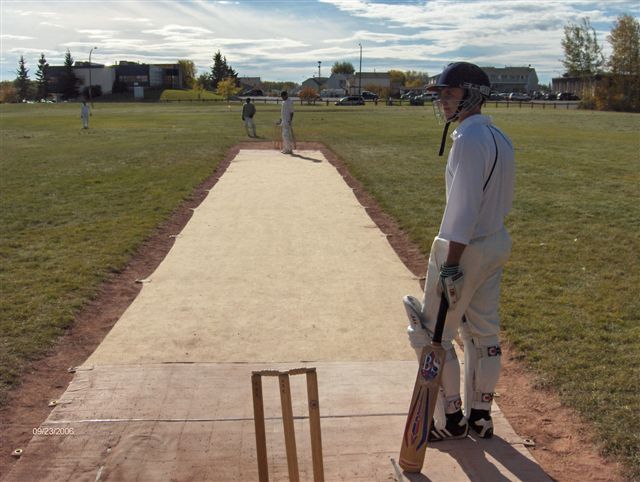 | 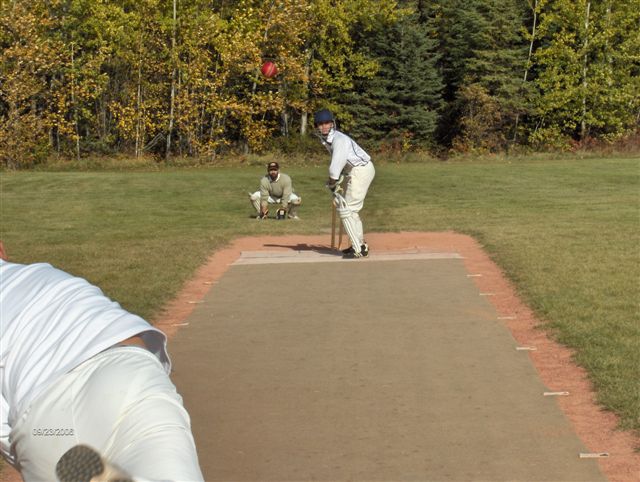 | 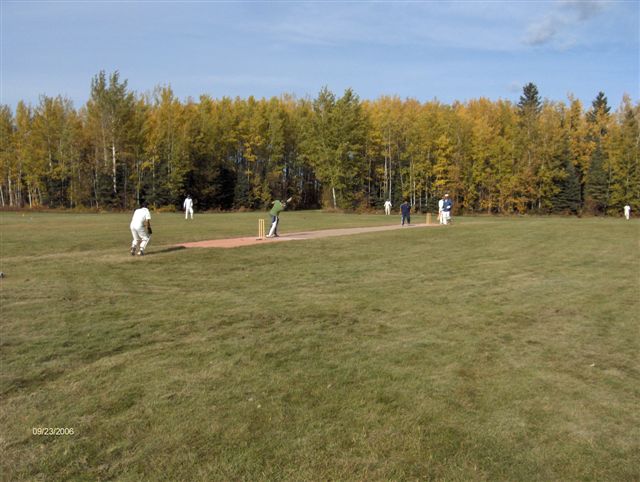 |
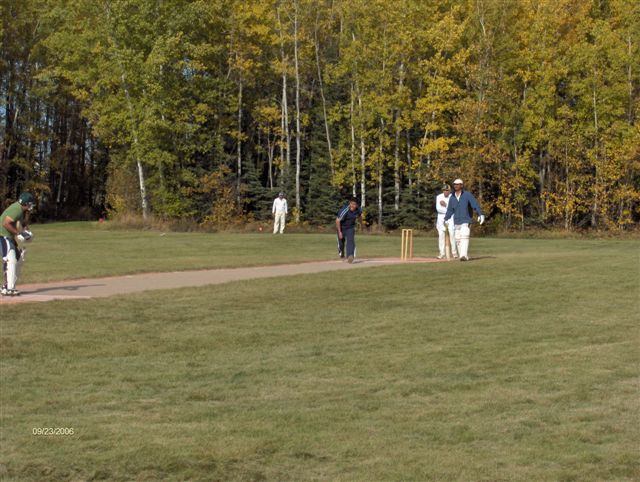 |  |  |
 |  | 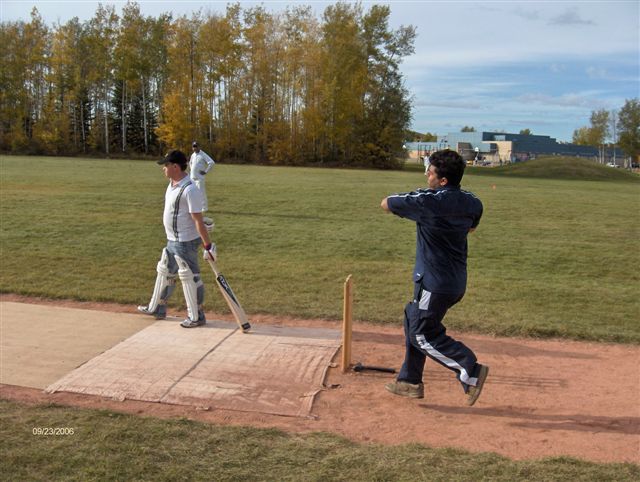 |
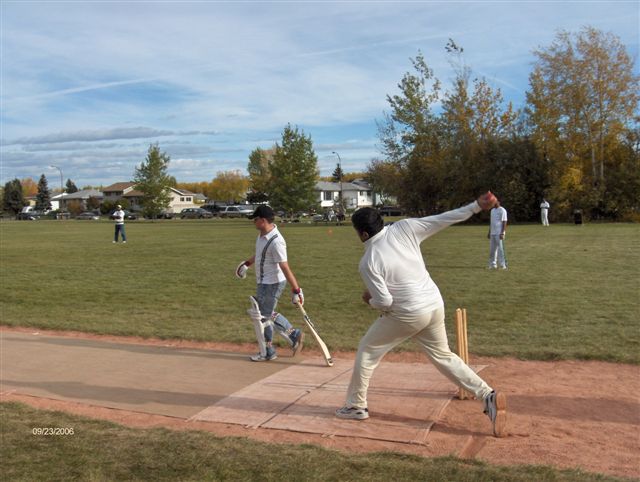 | 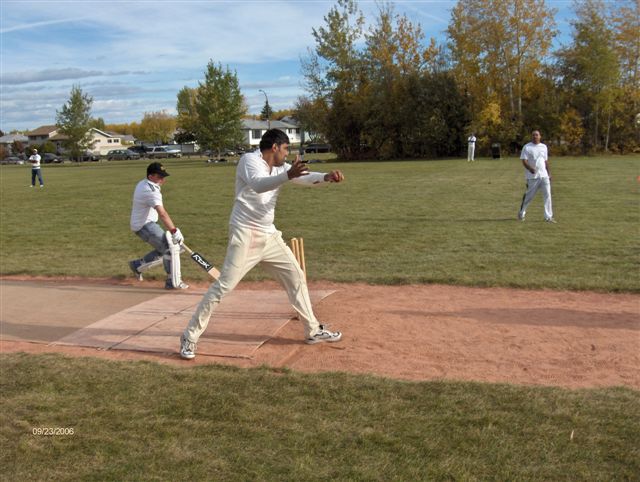 | 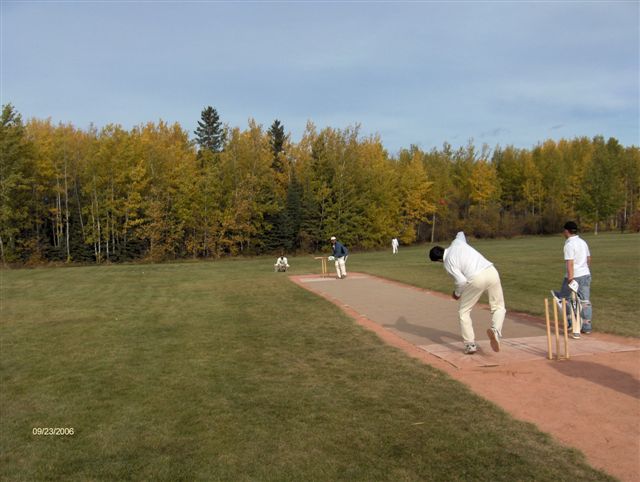 |
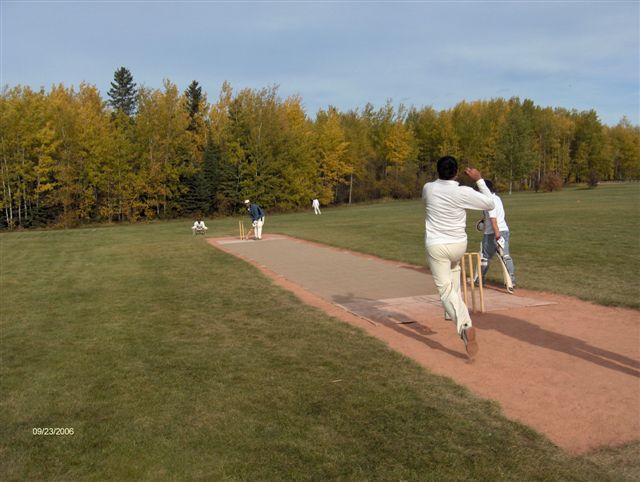 | 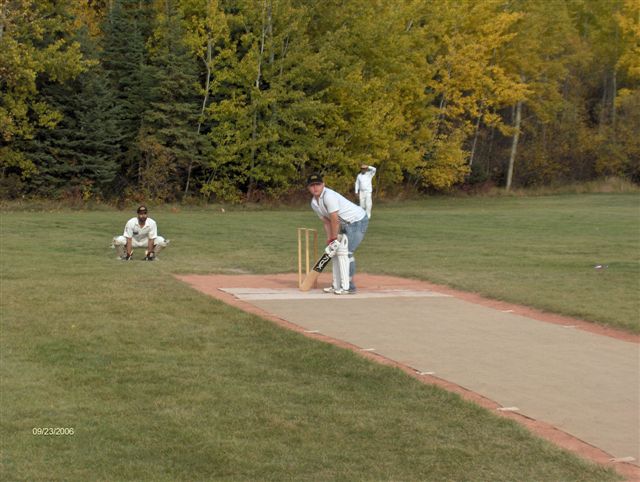 | 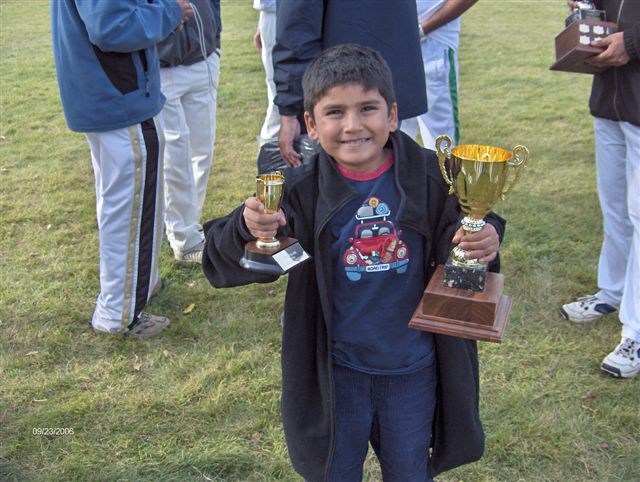 |
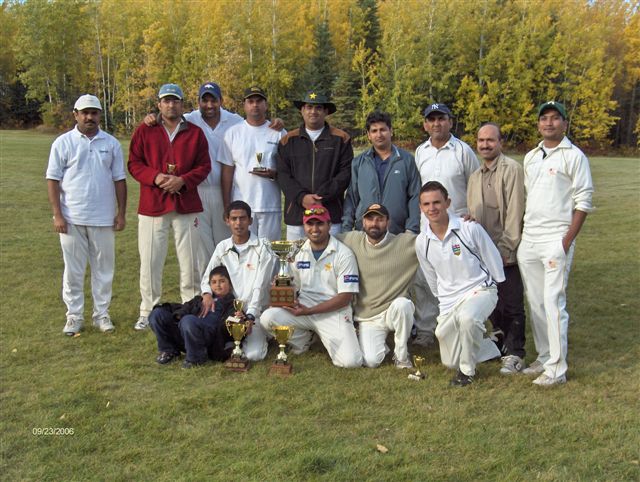 | 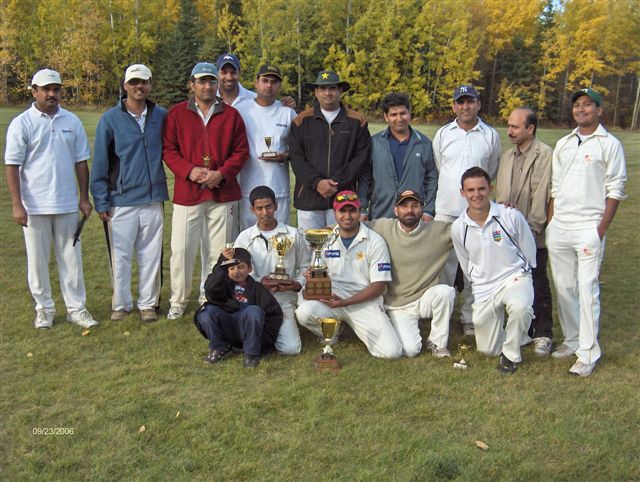 |
India refuse to sign ICC contract -- Posted Tuesday, October 3 2006
Cricket powerhouse India are refusing to sign an International Cricket Council agreement which would bind it to global ICC events until 2015.
The cricket board would not say what it was objecting to but said it had written to the ICC.
The ICC is aiming to raise hundreds of millions of pounds through the sale of media and sponsorship rights.
"We can't accept the ICC's particpating nations agreement in its current form," said India treasurer N Srinivasan.
"We've got certain reservations about its terms. We'll not sign it until our objections are resolved."
The ICC, whose existing seven-year media deal expires at the end of the 2007 World Cup, began meetings with broadcasters and media agencies on Tuesday for the sale of rights from late 2007 to 2015.
It is expected to double its existing $550m (£291.5m) deal when the new contract is finalised to cover 18 tournaments, including two World Cups, three Champions Trophies and the first two Twenty20 world championships.
The Board for Control of Cricket in India caused a major row ahead of the last World Cup in South Africa in 2003 when it declined to sign the participating nations' agreement over the controversial ambush marketing laws enforced by the ICC.
The BCCI objected to the clause which prevented its players from advertising products of companies that were rivals of the ICC's official sponsors for a month on either side of the World Cup.
India later relented and sent a team for the tournament but the media company which had the rights, the Global Cricket Corporation, withheld almost $47m in payment to the ICC.
India are due to host the 2011 World Cup - which forms part of the new agreement - jointly with its South Asian neighbours Pakistan, Sri Lanka and Bangladesh.
Article sourced from:-
http://news.bbc.co.uk/sport1/hi/cricket/other_international/india/5386288.stm
Toronto and District Cricket Association - Playoffs -- Posted Tuesday, October 3 2006
October 1st proved a good day for the Mississauga Ramblers club. Their colts (under-19) side won that section of the Toronto & District junior championships, beating Overseas by 3 wickets. Their Under-15's beat Caledonia by 28 runs to win that section of the T&D. Both games took place at Maple Leaf CC, King City.
In the U-19 match, Overseas batted first and made 124. Owais Ahmend top-scored with 25 while Amrish Deraj lead the Ramblers bowling with 4-26 in 6.3 overs. The total was almost certainly disappointing for Overseas, as I was told they hit plenty of runs in Saturday's semi-final. But such is cricket, indeed such is sport. You win some, you lose some. You have good or great days, then there are the bad. The key thing is to learn from the various experiences.
At the scheduled lunch break, Ramblers were 35-0 off just 7 overs.
A switch to the spinners lead to a turn around in Overseas fortunes; not necessarily immediately but they did fight back. The increased excitement with each dismissal prompted me to venture from the OCA Championship game to check on the Colts final.
Overseas had taken six wickets in the post-lunch session and the scoring rate had declined. Even so, the Ramblers reached the century mark in the 25th over....but with 6 wickets down. Ramblers kept their heads to reach 125-7 in the 33rd over and thus won the match. Derjaj clearly took the individual honours as he top scored with 35 runs in addition to his return of 4 wickets.
In the Under-15 final, the Ramblers batted first and made 141. Ali Aslam made 50 and Shyam Vijay Aragmavan 31. Caledonia made 113 all out, the innings ending in the 28th over. I did see the 5th (catch) and 6th (run out) wickets fall in quick succession. Betrum Miles took 4-26.
Seniors
The senior 3rd Division championship also took place at Maple Leaf CC on October 1st. It was won by Bangla, who beat Woodbine by 3 wickets.
Woodbine batted first, making 181. Pathan Riyazkhan was top scorer with 51. Mohammed Shameed took 4-45 in this innings.
A brief glance at this match was taken during the Bangla innings when they seemed well set at 96-3 (22 overs). It became the last match in progress after the two junior and Ontario Cricket Association senior championship games came to an end.
The light was declining but at 169-5 after 46 overs, Bangla needed just 13 more runs for victory. But this is cricket and hope was, briefly - as it turned out -, rekindled for Woodbine through catches at deep mid-wicket (177-6) and then at a sort-of short-fine leg (180-7). The batsmen out were Abdul Hasan (top-scorer with 37) and then Haleepi Shah (34), so these dismissals in poor light were potentially key. A drive to long-on then sealed the game for Bangla.
Ameen Mahir made 33 in the earlier part of the Bangla innings.
Some of the fans were questioning playing on in the light....perhaps they should have been at Centennial Park, Etobicoke, for the previous day's OCA semi-final game. That got dark and it was even colder, especially with the rain!
Editorial comment:- More fine reporting. Thanks Eddie.
Young Malton win OCA Championship -- Posted Monday, October 2 2006
Young Malton win Ontario Cricket Association (OCA) Championship
Scoring Summary:
Young Malton 255 (48.5 overs; Enos McDonald 90, Balaji Rao 44, Nadim Khan 33, Azeemul Haniff 32; Akber Hussain 4-48)
Canterbury 120 (33.4 overs; Tauseef Shamid 30; Puvendran Ravishankar 4-25, including a hat trick to end the game)
Report
Young Malton (Etobicoke & District League) beat Canterbury CC (Ottawa Valley) by 135 runs on Sunday October 1 in the final of the OCA Championship. They took the championship trophy and a prize of $2,000.
The Young Malton side got off to a flying start, making 97 before losing their first wicket. Enos McDonald was top scorer with 90 (6x 6; 8x4) and his opening partner, Belaji Rao made 44 (3x6, 3x4). Canterbury missed several catches and probably paid dearly as the opening barrage may have ended before the score reached 30.
Azeemul Haniff (32) and Nadim Khan (33) helped keep the innings flowing. Akber Hussain took the last four Young Malton wickets; the innings ending on 255 all out in the 49th over of a possible 50.
Young Malton bowled tidily and took two early wickets but no one really dominated for Canterbury. There was a promising stand of 49 for their 5th wicket but the innings quickly folded after Akber Hussain was out for 25 (112-5).
Six runs later they lost Tauseef Shamid for 30 and the innings crumbled to 120 all out. Puvendran Ravishankar was brought on to bowl the 34th over and closed the proceedings with a hattrick. He had Khurshad leg-before wicket, then was delighted by 'a brilliant left handed catch' from wicketkeeper Pubbudu Dassanayake. 'For the last wicket, the ball turned and he was stumped', by Dassanayake.
Note for publication: Our reporter expects to provide a full scorecard and some pictures in the next day or so. Picture provision depends on a return to health of a dead laptop computer.
Toronto and District Cricket Association - Junior Playoffs
October 1st proved a good day for the Mississauga Ramblers club. Their colts (under-19) side won that section of the Toronto & District junior championships, beating Overseas by 3 wickets. Their Under-15's beat Caledonia by 28 runs to win that section of the T&D. Both games took place at Maple Leaf CC, King City.
In the U-19 match, Overseas batted first and made 124. Owais Ahmend top-scored with 25 while Amrish Deraj lead the Ramblers bowling with 4-26 in 6.3 overs. The total was almost certainly disappointing for Overseas, as I was told they hit plenty of runs in Saturday's semi-final. But such is cricket, indeed such is sport. You win some, you lose some. You have good or great days, then there are the bad. The key thing is to learn from the various experiences.
At the scheduled lunch break, Ramblers were 35-0 from just 7 overs.
A switch to the spinners lead to a turn around in Overseas fortunes; not necessarily immediately but they did fight back. The increased excitement with each dismissal prompted me to venture from the OCA Championship game to check on the Colts final.
Overseas had taken six wickets in the post-lunch session and the scoring rate had declined. Even so, the Ramblers reached the century mark in the 25th over....but with 6 wickets down. Ramblers kept their heads to reach 125-7 in the 33rd over and thus won the match. Derjaj clearly took the individual honours as he top scored with 35 runs in addition to his return of 4 wickets.
In the Under-15 final, the Ramblers batted first and made 141. Ali Aslam made 50 and Shyam Vijay Aragmavan 31. Caledonia made 113 all out, the innings ending in the 28th over. I did see the 5th (catch) and 6th (run out) wickets fall in quick succession. Betrum Miles took 4-26.
Seniors
The senior 3rd Division championship also took place at Maple Leaf CC on October 1st. It was won by Bangla, who beat Woodbine by 3 wickets.
Woodbine batted first, making 181. Pathan Riyazkhan was top scorer with 51. Mohammed Shameed took 4-45 in this innings.
A brief glance at this match was taken during the Bangla innings when they seemed well set at 96-3 (22 overs). It became the last match in progress after the two junior and Ontario Cricket Association senior championship games came to an end.
The light was declining but at 169-5 after 46 overs, Bangla needed just 13 more runs for victory. But this is cricket and hope was, briefly - as it turned out -, rekindled for Woodbine through catches at deep mid-wicket (177-6) and then at a sort-of short-fine leg (180-7). The batsmen out were Abdul Hasan (top-scorer with 37) and then Haleepi Shah (34), so these dismissals in poor light were potentially key. A drive to long-on then sealed the game for Bangla.
Ameen Mahir made 33 in the earlier part of the Bangla innings.
Some of the fans were questioning playing on in the light....perhaps they should have been at Centennial Park, Etobicoke, for the previous day's OCA semi-final game. That got dark and it was even colder, especially with the rain!
Scoring highlights exist from all three matches and will follow, almost certainly on Monday. (But the dead laptop situation, an impending expiry of time at an internet cafe and, for once, the reporters desire for food limit tonight's report to the barest of facts.).
http://blogs.cricinfo.com/btw/archives/2006/10/young_malton_wi.php
The champions with the trophy..
OCA Championship report -- Posted Monday, October 2 2006
Young Malton win Ontario Cricket Association (OCA) Championship
Scoring Summary:
Young Malton 255 (48.5 overs; Enos McDonald 90, Balaji Rao 44, Nadim Khan 33, Azeemul Haniff 32; Akbar Hussain 4-48)
Canterbury 120 (33.4 overs; Tauseef Shamid 30; Puvendran Ravishankar 4-25, including a hat trick to end the game)
Report
Young Malton (Etobicoke & District League) beat Canterbury CC (Ottawa Valley) by 135 runs on Sunday October 1 in the final of the OCA Championship. They took the championship trophy and a prize of $2,000.
The Young Malton side got off to a flying start, making 97 before losing their first wicket. Enos McDonald was top scorer with 90 (6x 6; 8x4) and his opening partner, Belaji Rao made 44 (3x6, 3x4). Canterbury missed several catches and probably paid dearly as the opening barrage may have ended before the score reached 30.
Azeemul Haniff (32) and Nadim Khan (33) helped keep the innings flowing. Akber Hussain took the last four Young Malton wickets; the innings ending on 255 all out in the 49th over of a possible 50.
Young Malton bowled tidily and took two early wickets but no one really dominated for Canterbury. There was a promising stand of 49 for their 5th wicket but the innings quickly folded after Akber Hussain was out for 25 (112-5). Six runs later they lost Tauseef Shamid for 30 and the innings crumbled to 120 all out. Puvendran Ravishankar was brought on to bowl the 34th over and closed the proceedings with a hattrick. He had Khurshad leg-before wicket, then was delighted by 'a brilliant left handed catch' from wicketkeeper Pubbudu Dassanayake. 'For the last wicket, the ball turned and he was stumped', by Dassanayake.
Note for publication: Our reporter expects to provide a full scorecard and some pictures in the next day or so. Picture provision depends on a return to health of a dead laptop computer.
Toronto and District Cricket Association - Junior Playoffs
October 1st proved a good day for the Mississauga Ramblers club. Their colts (under-19) side won that section of the Toronto & District junior championships, beating Overseas by 3 wickets. Their Under-15's beat Caledonia by 28 runs to win that section of the T&D. Both games took place at Maple Leaf CC, King City.
In the U-19 match, Overseas batted first and made 124. Owais Ahmend top-scored with 25 while Amrish Deraj lead the Ramblers bowling with 4-26 in 6.3 overs. The total was almost certainly disappointing for Overseas, as I was told they hit plenty of runs in Saturday's semi-final. But such is cricket, indeed such is spot. You win some, you lose some. You have good or great days, then there are the bad. The key thing is to learn from the various experiences.
At the scheduled lunch break, Ramblers were 35-0 off just 7 overs.
A switch to the spinners lead to a turn around in Overseas fortunes; not necessarily immediately but they did fight back. The increased excitement with each dismissal prompted me to venture from the OCA Championship game to check on the Colts final.
Overseas had taken six wickets in the post-lunch session and the scoring rate had declined. Even so, the Ramblers reached the century mark in the 25th over....but with 6 wickets down. Ramblers kept their heads to reach 125-7 in the 33rd over and thus won the match. Derjaj clearly took the individual honours as he top scored with 35 runs in addition to his return of 4 wickets.
In the Under-15 final, the Ramblers batted first and made 141. Ali Aslam made 50 and Shyam Vijay Aragmavan 31. Caledonia made 113 all out, the innings ending in the 28th over. I did see the 5th (catch) and 6th (run out) wickets fall in quick succession. Betrum Miles took 4-26.
Seniors
The senior 3rd Division championship also took place at Maple Leaf CC on October 1st. It was won by Bangla, who beat Woodbine by 3 wickets.
Woodbine batted first, making 181. Pathan Riyazkhan was top scorer with 51. Mohammed Shameed took 4-45 in this innings.
A brief glance at this match was taken during the Bangla innings when they seemed well set at 96-3 (22 overs). It became the last match in progress after the two junior and Ontario Cricket Association senior championship games came to an end.
The light was declining but at 169-5 after 46 overs, Bangla needed just 13 more runs for victory. But this is cricket and hope was, briefly - as it turned out -, rekindled for Woodbine through catches at deep mid-wicket (177-6) and then at a sort-of short-fine leg (180-7). The batsmen out were Abdul Hasan (top-scorer with 37) and then Haleepi Shah (34), so these dismissals in poor light were potentially key. A drive to long-on then sealed the game for Bangla.
Ameen Mahir made 33 in the earlier part of the Bangla innings.
Some of the fans were questioning playing on in the light....perhaps they should have been at Centennial Park, Etobicoke, for the previous day's OCA semi-final game. That got dark and it was even colder, especially with the rain!
October 1st was a good day for the Mississauga Ramblers. Their colts (under-19) side won that section of the Toronto & District junior championships, beating Overseas by 3 wickets. Their Under-15's beat Caledonia by 28 runs.
Both games took place at Maple Leaf CC, as did the senior 3rd Division championship, which was won by Bangla, who beat Woodbine.
Scoring highlights exist from all three matches and will follow, almost certainly on Monday. (But the dead laptop situation, an impending expiry of time at an internet cafe and, for once, the reporters desire for food limit tonight's report to the barest of facts.)
(Many thanks to our reporter for spending two days covering three plus matches, and we hope that the lap top will be resuscitated. JH).
Toronto's Yorkshire CC beaten by Young Malton CC -- Posted Sunday, October 1 2006
Young Malton of the Etobicoke & District League will meet Canterbury CC (Ottawa Valley) in the Ontario Cricket Association (OCA) Championships on Sunday (Oct 1) at Maple Leaf CC, King City. The match is scheduled for a 10am start.
Young Malton pulled off what would be regarded as a surprise win on Saturday (Sept 30) over Yorkshire CC, the Toronto & District Cricket Association champions, at Centennial Park, Etobicoke. They won this OCA semi-final by 5 wickets.
Yorkshire won the toss and batted on a cool and cloudy day. Asif Mulla and Vary Grewal provided a solid start. Grewal was out for 30 (65-1) to end the 19th over. The outfield was damp and a few well-struck shots pulled up well short of the boundary. Asif hit one powerful six over wide long-on that resulted in a lost ball. He was run out for 55 (132-6).
Yorkshire made 163 all out (49 overs). Mohsin Mulla (17) was the only other batsman to reach double-figures. Sase Narine took 3-26 and Raj Ranhhawa 3-28.
Young Malton lost one wicket in the first over and their other opener was forced to retire hurt. Idris Gangatt and Azemal Hannif set the scoreboard ticking, reaching 39 (8 overs) before settling to a rate of 4 runs an over. Conditions became more testing for both sides as first the wind increased and then rain set in. Young Malton reached 100 for the loss of 3 wickets. Gangutt made 43 and Hannif 32.
The light became increasingly testing, but Yorkshire's bowlers and fielders deserve praise for containing the scoring. Only 24 runs were made in the ten overs between the 31st and 40th. Pubudu Dassanayaka played steadily, eventually stroking the winning single to reach 26 not out.
The players, supporters, officials and other cricket lovers who braved the latter stages of this day, will be hoping for a drier time in the final on Sunday at King City.
Eddie Norfolk
